Sep 18, 2026CNC Machining Guides
Metal Stamping vs. CNC Machining: Which Process Fits Your Part?
Compare metal stamping and CNC machining by part geometry, materials, tolerances, tooling, production quantity, design changes, finishing, inspection, and cost.
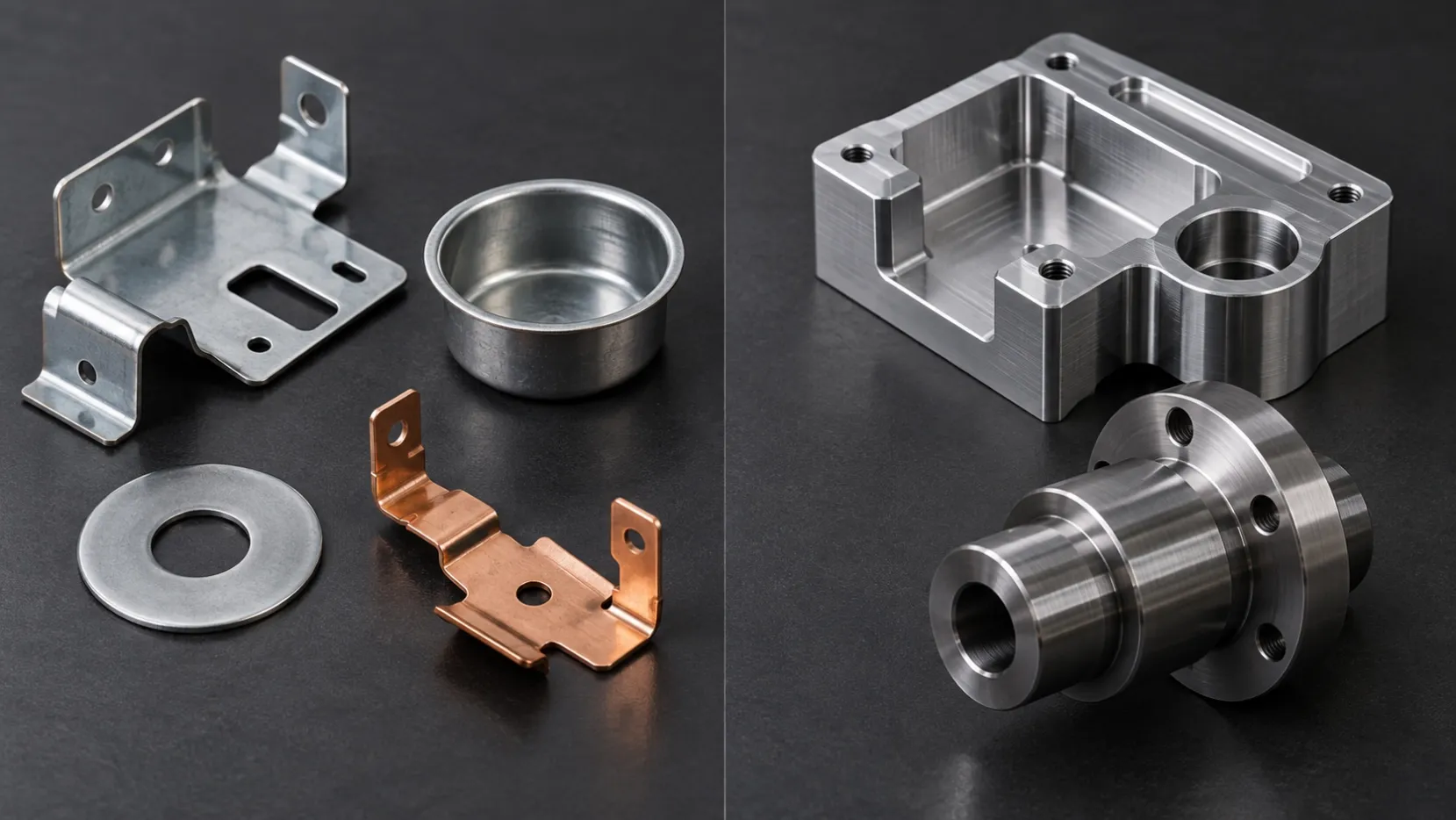
Metal stamping and CNC machining can both produce custom metal components, but they use different material forms, tooling, production methods, and cost structures.
CNC machining removes material from a solid block, plate, bar, or other starting form. Metal stamping cuts and forms sheet or strip material using punches, dies, and controlled press operations.
The right choice depends on part geometry, material thickness, quantity, tolerances, design maturity, surface requirements, tooling investment, and future demand.
What Is CNC Machining?
CNC machining is a subtractive manufacturing process. Cutting tools remove material according to a programmed toolpath.
Common CNC processes include:
- Milling
- Turning
- Drilling
- Boring
- Threading
- Tapping
- Grooving
- Other drawing-based machining operations
CNC machining is commonly considered for parts with:
- Three-dimensional geometry
- Thick sections
- Deep pockets
- Precision bores
- Multiple stepped diameters
- Threads
- Tight feature relationships
- Features on several faces
- Prototype or changing designs
- Low-to-medium production quantities
What Is Metal Stamping?
Metal stamping uses press tooling to cut or form sheet or strip material.
Depending on the component, operations may include:
- Blanking
- Piercing
- Bending
- Forming
- Drawing
- Coining
- Flanging
- Progressive operations
- Secondary machining or assembly
Metal stamping is commonly considered for parts with:
- Relatively uniform sheet thickness
- Punched holes
- Formed flanges
- Bent profiles
- Clips
- Contacts
- Brackets
- Covers
- Washers
- Shallow drawn features
- Repeat production demand
The Main Difference: Removing Material vs. Forming Sheet
CNC machining creates geometry by removing material from a larger workpiece.
Metal stamping creates geometry by cutting and forming sheet or strip.
This difference affects:
- Part thickness
- Geometry
- Material utilization
- Tooling
- Production quantity
- Design-change flexibility
- Cycle planning
- Edge condition
- Surface appearance
- Unit cost
A thick housing with pockets and threaded holes is generally suited to machining. A thin formed bracket with punched holes may be better suited to stamping.
Compare the Starting Material
CNC machining may begin with:
- Bar
- Plate
- Block
- Tube
- Forging
- Casting
- Near-net-shape blank
Metal stamping generally begins with:
- Sheet
- Strip
- Coil
- Flat blank
If the part requires thick, non-uniform sections or large differences in height that cannot be formed from sheet, CNC machining may be more appropriate.
If the design maintains relatively consistent sheet thickness and relies on bends or formed walls, stamping may be a stronger candidate.
Compare Part Geometry
Geometry Often Suited to CNC Machining
CNC machining may be preferred for:
- Solid three-dimensional parts
- Precision housings
- Deep pockets
- Stepped shafts
- Precision bushings
- Internal bores
- Threads
- Complex contours
- Small internal features
- Features located on several sides
Geometry Often Suited to Metal Stamping
Metal stamping may be preferred for:
- Flat washers
- Clips
- Electrical contacts
- Sheet brackets
- Retainers
- Covers
- Spring-like formed components
- Parts with punched holes
- Parts with repeated bends
- Shallow cups or drawn features
The complete drawing should be reviewed because one part may contain features associated with both processes.
Production Quantity Affects the Decision
Quantity is one of the most important factors.
CNC machining typically requires programming, setup, workholding, tooling, machining time, and inspection. It often provides flexibility without requiring dedicated production dies.
Metal stamping may require component-specific tooling, but once the tooling and process are established, it can support efficient repeat production.
This does not mean stamping is always lower cost or machining is only for prototypes.
The practical choice depends on:
- Part complexity
- Required quantity
- Tooling cost
- Material utilization
- Secondary operations
- Inspection
- Finishing
- Design maturity
- Repeat demand
Ask for pricing based on realistic prototype, pilot, and production quantities.
Tooling Investment
CNC machining commonly uses standard cutting tools and adaptable workholding, although special fixtures or tools may still be required.
Metal stamping may require:
- Blanking tools
- Forming tools
- Piercing tools
- Progressive dies
- Draw tooling
- Gauges
- Dedicated fixtures
Tooling cost should be considered separately from part price.
Before approving stamping tooling, confirm:
- Drawing revision
- Expected annual quantity
- Tool ownership
- Tool maintenance
- Tool storage
- Expected tool life
- Replacement responsibility
- Engineering-change procedure
A stable design is important before committing to dedicated tooling.
Design Changes
CNC machining is generally more flexible when the design is still changing. Programming, setup, or workholding may be revised without rebuilding an entire stamping die, depending on the change.
A design change to a stamped part may require:
- Die modification
- New inserts
- New forming stations
- New inspection gauges
- Tool revalidation
- New samples
For early prototypes, CNC machining or simplified sheet fabrication may be used to evaluate fit and function before production tooling is approved.
However, a machined prototype may not perfectly reproduce the material behavior, edge condition, grain direction, work hardening, or formed geometry of the final stamped part.
Tolerance Considerations
Both processes can manufacture controlled components, but tolerance capability depends on the feature, material, geometry, tooling, process sequence, and inspection method.
CNC machining may be appropriate for controlling:
- Precision bores
- Turned diameters
- Machined faces
- Hole locations
- Threads
- Datum relationships
- Surface roughness
Metal stamping may be appropriate for controlling:
- Blank profiles
- Punched-hole positions
- Bend locations
- Formed features
- Repeated sheet geometry
Stamped-part dimensions can be affected by:
- Material thickness
- Grain direction
- Springback
- Tool wear
- Forming sequence
- Burr direction
- Flatness
- Residual stress
Do not assume that a tolerance achievable on a machined part transfers directly to a stamped version without review.
Wall Thickness and Material Thickness
A machined part can contain significantly different wall thicknesses because material is selectively removed.
A stamped part normally retains the starting sheet thickness, although local thinning may occur during forming or drawing.
If the design requires:
- Thick bosses
- Deep threaded holes
- Large solid sections
- Very different local thicknesses
CNC machining may be more appropriate, or the design may require multiple components and assembly.
If uniform sheet thickness is acceptable, stamping may reduce unnecessary material removal.
Material Utilization
CNC machining may remove a significant amount of material from a solid blank, depending on the geometry.
Stamping can use nested blanks or coil layouts, but still creates scrap around profiles and pierced features.
Material utilization depends on:
- Part shape
- Nesting
- Strip layout
- Grain direction
- Carrier requirements
- Edge distance
- Raw material form
- Scrap handling
Material cost should be evaluated as part of the complete manufacturing route.
Burrs and Edge Conditions
Both processes can produce burrs, but the burr location and removal method differ.
For CNC machined parts, burrs may occur at:
- Hole exits
- Intersecting features
- Milled edges
- Threads
- Cross holes
- Grooves
For stamped parts, burrs may occur along:
- Blanked edges
- Pierced holes
- Cut profiles
- Sheared features
The drawing should define:
- Burr direction where relevant
- Maximum acceptable burr
- Required edge break
- Sharp functional edges
- Deburring method
- Cosmetic surfaces
- Handling requirements
Do not rely only on a general note when the edge condition affects assembly or safety.
Bending and Springback
Stamped bends and formed features may change after the forming force is removed. This behavior is commonly described as springback.
Springback depends on:
- Material
- Thickness
- Hardness
- Grain direction
- Bend radius
- Bend angle
- Tooling
- Forming sequence
The production tooling and inspection plan must account for the required final geometry.
A sharp internal bend may be impractical or may increase the risk of cracking. Use realistic bend radii according to the material and application.
Surface Finish and Cosmetic Appearance
CNC machining may leave visible toolpaths, turning marks, or differences between operations.
Metal stamping may retain the sheet or coil surface but can introduce:
- Tool contact marks
- Draw marks
- Bend marks
- Surface variation
- Edge burrs
- Handling marks
Both processes may use secondary finishing such as:
- Plating
- Anodizing
- Passivation
- Coating
- Polishing
- Deburring
- Heat treatment
- Cleaning
Define cosmetic surfaces, viewing requirements, coating thickness, masking, and packaging before quotation.
Secondary Operations
A stamped component may still require:
- Tapping
- Reaming
- Machining
- Welding
- Riveting
- Fastener insertion
- Heat treatment
- Plating
- Cleaning
- Assembly
A CNC machined component may require:
- Heat treatment
- Grinding
- Coating
- Deburring
- Marking
- Assembly
- Special inspection
The best process is the one that satisfies the complete finished-part requirement, not only the first manufacturing operation.
Inspection Requirements
CNC machined components may require inspection of:
- Diameters
- Bores
- Hole positions
- Datum relationships
- Runout
- Surface roughness
- Threads
Stamped components may require inspection of:
- Profile
- Hole position
- Bend angle
- Form height
- Flatness
- Burr condition
- Material thickness
- Cosmetic appearance
For either process, define:
- Critical dimensions
- Sampling plan
- First-article requirements
- Material certificates
- Coating certificates
- Inspection reports
- Lot traceability
When CNC Machining May Be the Better Choice
CNC machining may be the better starting point when:
- Quantity is relatively low
- The design is still changing
- The part is solid or three-dimensional
- Thick sections are required
- Precision bores or threads are important
- Multiple feature depths are required
- Tooling investment must be minimized
- Fast design iteration is important
The final decision still requires review of the drawing and RFQ.
When Metal Stamping May Be the Better Choice
Metal stamping may be the better starting point when:
- The part is made from sheet or strip
- Thickness is relatively uniform
- Geometry includes punched and formed features
- Demand supports dedicated tooling
- Repeatability across production is important
- Material utilization can be optimized
- The design is stable
- Production is expected to repeat
Tooling, finishing, inspection, and secondary operations must still be included in the evaluation.
When Both Processes Are Used
Some components or assemblies require both stamping and machining.
Examples include:
- Stamped parts with machined precision holes
- Formed brackets with tapped features
- Stamped housings with turned inserts
- Machined shafts combined with stamped retainers
- Stamped electrical contacts with secondary machining
- Assemblies containing both machined and formed parts
Submit the complete drawing set so the manufacturing sequence and interfaces can be reviewed together.
RFQ Checklist
Provide:
- Current 2D drawing
- Matching 3D model
- Exact material and condition
- Material thickness
- Prototype quantity
- Production quantity
- Estimated annual demand
- Critical tolerances
- Bend and form requirements
- Edge and burr requirements
- Threads and secondary machining
- Surface finish
- Inspection documentation
- Tooling ownership requirements
- Packaging
- Target delivery date
If the production process has not been selected, state the functional requirements and request a manufacturing review.
Request a Manufacturing Review
Zync Precision reviews customer drawings for CNC machining and custom precision metal stamping according to geometry, material, quantity, tolerances, finishing, inspection, and delivery requirements.
Send the complete drawing and 3D model together with your expected prototype and production quantities.