Sep 18, 2026CNC Machining Guides
Common Surface Finishes for CNC Machined Parts
Compare as-machined finishes, anodizing, plating, passivation, polishing, coating, heat treatment, and other finishing options for custom CNC machined parts.
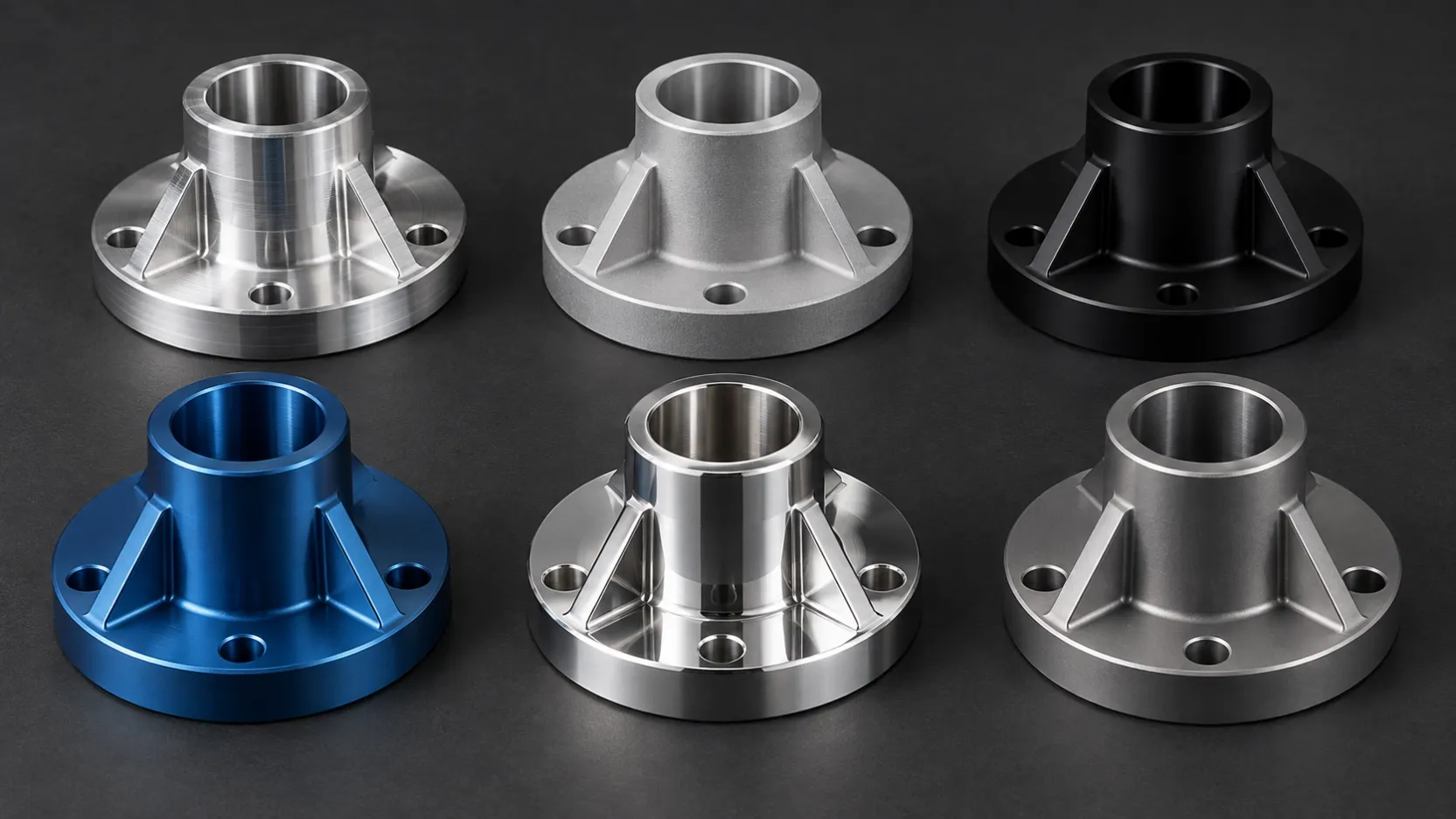
Surface finishing can change the appearance, corrosion resistance, wear behavior, friction, electrical performance, cleanliness, and dimensional condition of a CNC machined part.
The correct finish depends on the base material, application, environment, tolerances, cosmetic expectations, quantity, and cost target. A finish should not be selected only by color or appearance.
This guide explains common finishing options and the information buyers should include when requesting a quotation.
Start with the Base Material
Not every finish is suitable for every material.
Before selecting a process, confirm:
- Exact material grade
- Temper or hardness
- Required corrosion resistance
- Wear conditions
- Electrical conductivity
- Operating temperature
- Chemical exposure
- Cosmetic requirements
- Critical tolerances
- Masked surfaces
- Required documentation
Aluminum, stainless steel, carbon steel, alloy steel, brass, copper, and engineering plastics may require different preparation and finishing processes.
Always review the finish together with the base material and part geometry.
As-Machined Finish
An as-machined part is supplied after machining, deburring, cleaning, and required inspection, without an additional coating or cosmetic treatment unless otherwise specified.
An as-machined surface may show:
- Toolpath patterns
- Turning lines
- Minor color variation
- Different appearances between machined faces
- Deburred edges
- Normal handling marks within the agreed acceptance criteria
Potential advantages include:
- No coating thickness
- Shorter process route
- Lower finishing cost
- Easy access for dimensional inspection
- Suitable for many internal or non-cosmetic components
Important considerations include:
- Appearance may vary with tool direction and geometry
- Carbon and alloy steels may require corrosion protection
- Cosmetic expectations must be stated clearly
- Surface roughness should be specified separately
“As machined” does not automatically define a particular roughness or cosmetic standard. Include the required roughness value where it is functionally important.
Bead Blasting
Bead blasting creates a more uniform matte appearance by directing fine media at the part surface.
It may be considered for:
- Reducing visible machining-direction differences
- Producing a matte cosmetic surface
- Preparing some surfaces for subsequent finishing
- Creating a more consistent visual texture
Important considerations include:
- Media type and size affect appearance
- Sharp edges may change slightly
- Critical surfaces may require masking
- Internal passages must be cleaned thoroughly
- Blasting does not replace corrosion protection
- Batch-to-batch appearance may vary
Define which surfaces require blasting and which must remain protected.
Anodizing for Aluminum
Anodizing is an electrochemical treatment commonly applied to suitable aluminum alloys. It can improve corrosion behavior, surface durability, and appearance.
Possible requirements may include:
- Clear anodizing
- Black anodizing
- Colored anodizing
- Hard anodizing
- Sealed or unsealed condition
- Masked conductive areas
- Controlled coating thickness
Important considerations include:
- Alloy and temper affect final appearance
- Color may vary between material lots
- Coating changes surface dimensions
- Threads, precision bores, and mating surfaces may require allowance or masking
- Hard anodizing may create a different appearance from decorative anodizing
- Cosmetic acceptance should be agreed before production
Do not specify only a color. Include the required anodizing type, applicable standard, thickness where necessary, sealing, masking, and inspection requirements.
Passivation for Stainless Steel
Passivation is a chemical treatment used for suitable stainless steels after manufacturing and cleaning.
It may be requested to support surface cleanliness and corrosion performance by removing certain contaminants and supporting the natural passive condition of the stainless-steel surface.
Important considerations include:
- The exact stainless-steel grade
- Cleaning condition
- Applicable passivation process or standard
- Verification requirements
- Protection from later contamination
- Packaging and handling
Passivation is not a decorative coating and does not hide machining marks or scratches.
If appearance is important, specify the cosmetic requirements separately.
Electroless Nickel Plating
Electroless nickel plating can provide a relatively uniform deposited coating on suitable components, including areas that may be difficult to cover uniformly with some line-of-sight processes.
It may be considered for:
- Corrosion protection
- Wear-related applications
- Controlled surface properties
- Dimensional coating requirements
- Components with complex geometry
Important considerations include:
- Base material and preparation
- Required coating thickness
- Dimensional allowance
- Masked areas
- Thread fit
- Surface condition before plating
- Post-treatment requirements
- Inspection and certification
Critical dimensions should indicate whether they apply before or after plating.
Zinc Plating
Zinc plating is commonly considered for corrosion protection of suitable steel components.
Requirements may include:
- Coating type
- Coating thickness
- Color or conversion treatment
- Corrosion-performance requirement
- Masking
- Thread requirements
- Post-treatment
- Certification
Important considerations include:
- Coating adds material to surfaces
- Thread and fit allowances may be necessary
- Appearance can vary with process and geometry
- High-strength steels may require special review
- Handling and packaging affect finished appearance
Do not assume that all zinc-plated finishes are equivalent. Specify the required standard and acceptance criteria.
Black Oxide
Black oxide is a conversion treatment commonly associated with suitable ferrous materials. It can provide a dark appearance and may be used with oil or another protective treatment.
Potential reasons for selection include:
- Dark visual appearance
- Limited dimensional change
- Reduced light reflection
- Mild corrosion protection when combined with an appropriate protective treatment
Important considerations include:
- Base material
- Required post-treatment
- Corrosion expectations
- Appearance variation
- Cleaning and packaging
- Environmental exposure
Black oxide should not be selected when stronger corrosion protection is required without evaluating the service environment.
Powder Coating
Powder coating creates a comparatively thicker decorative and protective coating on suitable components.
It may be considered for:
- Exterior surfaces
- Equipment components
- Structural parts
- Color requirements
- General corrosion protection
- Durable cosmetic appearance
Important considerations include:
- Coating thickness
- Masked surfaces
- Threads and holes
- Mating faces
- Sharp edges
- Grounding points
- Cosmetic acceptance
- Cure-temperature compatibility
- Packaging
Powder coating is generally not appropriate on tight-fitting precision surfaces unless those areas are masked or dimensional allowances are planned.
Wet Painting
Wet paint may be used where a particular color, finish, touch-up method, or coating system is required.
The RFQ should define:
- Coating system
- Primer
- Color reference
- Gloss level
- Thickness
- Surface preparation
- Masking
- Cure requirements
- Environmental-performance requirements
- Cosmetic acceptance
A general color name is often insufficient when visual consistency is important.
Polishing
Polishing changes the surface appearance and may reduce visible machining marks or roughness, depending on the process.
It may be required for:
- Cosmetic surfaces
- Cleaning-related applications
- Reduced surface roughness
- Contact surfaces
- Decorative parts
- Certain process-equipment components
Important considerations include:
- Starting surface condition
- Required final roughness
- Directional or mirror-like appearance
- Edge preservation
- Dimensional change
- Internal feature accessibility
- Inspection method
Polishing can remove material. Critical dimensions and edges must be reviewed before processing.
Brushing
Brushing produces a directional surface pattern, usually for appearance.
Requirements should define:
- Brush direction
- Surface area
- Texture consistency
- Cosmetic acceptance
- Protected features
- Final cleaning
- Whether coating follows brushing
Because brushing is directional, the orientation should be defined on the drawing or an approved reference.
Tumbling and Vibratory Finishing
Tumbling or vibratory finishing may be used for deburring, edge smoothing, cleaning, or general surface improvement on suitable parts.
Important considerations include:
- Part size and geometry
- Media type
- Required edge condition
- Risk of part-to-part contact
- Protection of threads and precision surfaces
- Internal feature accessibility
- Cosmetic expectations
- Dimensional sensitivity
This process may not be suitable for fragile components, sharp functional edges, or surfaces that must remain precisely defined.
PVD Coating
Physical vapor deposition, or PVD, can create a thin functional or decorative coating on suitable materials and properly prepared surfaces.
Depending on the coating system, it may be considered for:
- Wear-related surfaces
- Low-friction applications
- Decorative appearance
- Surface hardness
- Components requiring a thin coating
Important considerations include:
- Base material
- Surface preparation
- Coating type
- Coating temperature
- Required thickness
- Color
- Masking
- Adhesion requirements
- Wear conditions
- Inspection
PVD is generally a line-of-sight process, so complex internal features may not receive the same coverage as exposed surfaces.
The coating supplier should review the material, heat-treatment condition, geometry, and functional requirements.
Heat Treatment Is Not the Same as Surface Coating
Heat treatment changes material properties through controlled heating and cooling. It is not simply a cosmetic surface finish.
Requirements may include:
- Hardening
- Tempering
- Stress relieving
- Case hardening
- Required hardness
- Case depth
- Protected areas
- Final machining
- Certification
Heat treatment may cause dimensional change or distortion. Critical parts may require machining before and after treatment.
State whether final dimensions apply before or after heat treatment.
How Finishing Affects Tolerances
Finishing can add material, remove material, change edges, or distort the component.
Review:
- Precision bores
- Shaft diameters
- Bearing fits
- Threads
- Sealing surfaces
- Hole positions
- Flatness
- Cosmetic edges
- Electrical-contact areas
- Grounding surfaces
The drawing should identify:
- Dimensions controlled before finishing
- Dimensions controlled after finishing
- Coating allowance
- Masked areas
- Plugged holes
- Protected threads
- Required final inspection condition
Do not expect the finisher to decide which dimensions are critical without clear instructions.
Masking Requirements
Masking protects selected surfaces from coating or treatment.
Common masked features may include:
- Threads
- Precision bores
- Bearing seats
- Mating surfaces
- Electrical contacts
- Grounding points
- Seal areas
- Identification areas
- Adhesive-bonding surfaces
Mark masked areas clearly on the drawing. General instructions such as “mask critical areas” are not sufficiently precise.
Cosmetic Acceptance Requirements
Cosmetic acceptance should be defined separately from dimensional acceptance.
Consider specifying:
- Viewing distance
- Lighting conditions
- Critical viewing surfaces
- Acceptable color range
- Gloss level
- Texture direction
- Allowed marks
- Handling requirements
- Approved reference sample
- Packaging protection
Words such as “perfect,” “smooth,” or “no defects” are difficult to inspect consistently without an agreed standard.
Surface-Finish Documentation
Depending on the project, required documents may include:
- Coating certificate
- Process certificate
- Thickness report
- Hardness report
- Material certificate
- Color or appearance approval
- First-article inspection
- Certificate of conformity
- Lot traceability
Identify document requirements before quotation.
How to Choose the Right Finish
Ask these questions:
- What is the base material?
- Is corrosion protection required?
- Is wear resistance important?
- Must the surface conduct or insulate electricity?
- Is appearance critical?
- What is the operating temperature?
- Will the part contact chemicals or moisture?
- Are there tight fits or threads?
- Which areas require masking?
- Is a specific color required?
- What documentation is needed?
- What quantity is required?
The finish should support the functional requirements of the complete part.
Surface-Finishing RFQ Checklist
Provide:
- Current drawing and 3D model
- Base material and condition
- Finishing process
- Applicable standard
- Required thickness where relevant
- Color and gloss requirements
- Surface roughness
- Masked areas
- Critical dimensions
- Before- or after-finish inspection condition
- Cosmetic acceptance criteria
- Certification requirements
- Quantity
- Packaging requirements
Complete information helps prevent incorrect assumptions during quotation.
Request a Surface-Finishing Review
Zync Precision reviews drawing-based machining and surface-treatment enquiries according to material, geometry, tolerances, appearance, masking, inspection, and documentation requirements.