Sep 18, 2026CNC Machining Guides
Prototype vs. Production CNC Machining: What Changes?
Compare prototype and production CNC machining, including design maturity, quantity, setup, tooling, inspection, finishing, documentation, cost, and delivery planning.
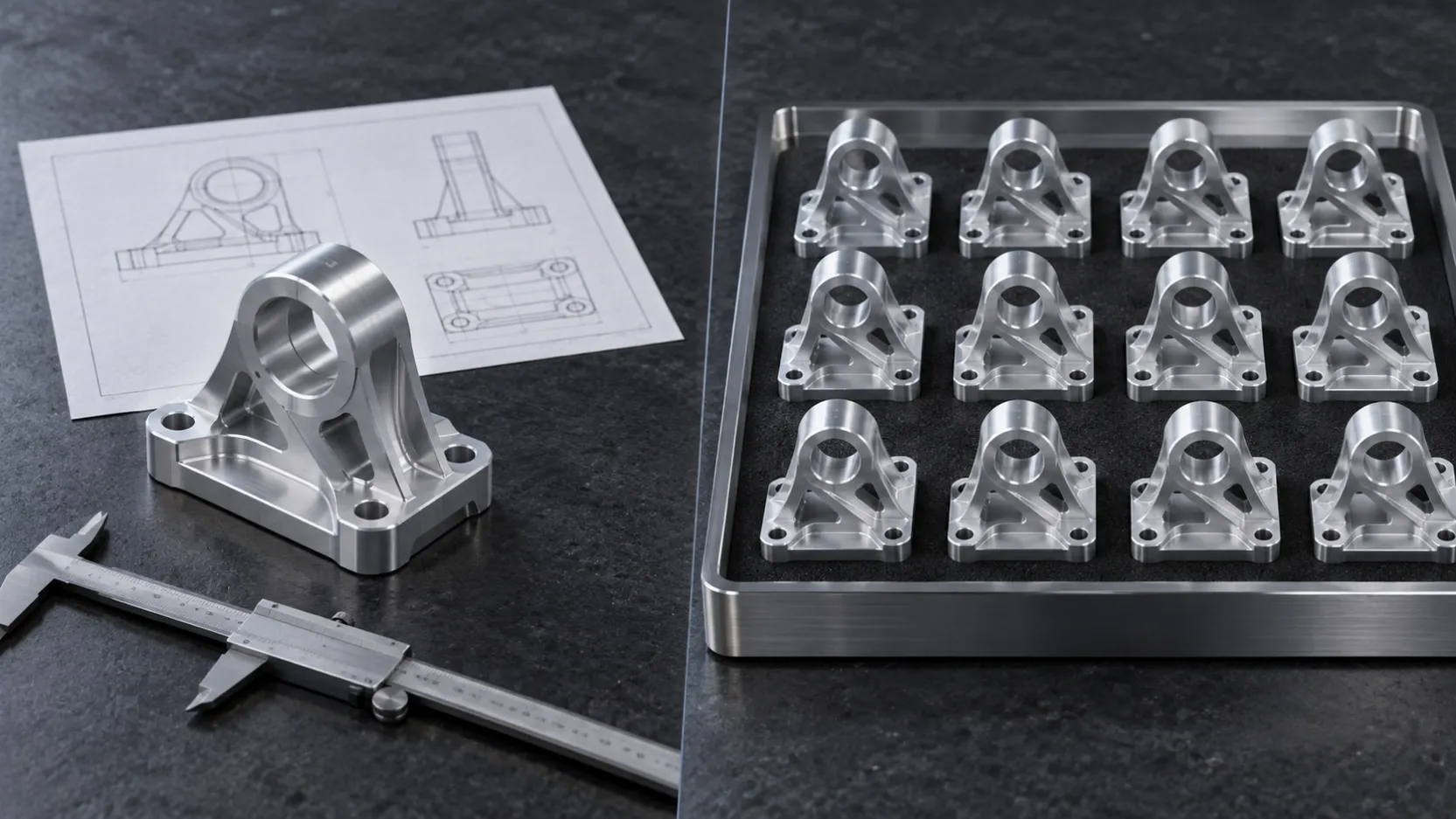
Prototype and production CNC machining may use the same drawing and similar equipment, but they are not managed in exactly the same way.
A prototype is usually intended to confirm geometry, assembly, function, material, or design assumptions. Production machining must repeatedly manufacture conforming parts using a stable process, controlled revisions, defined inspection, and reliable material and finishing requirements.
Understanding what changes between these stages helps engineers and buyers prepare better RFQs and avoid carrying unresolved prototype issues into production.
What Is Prototype CNC Machining?
Prototype CNC machining normally involves a small number of parts produced for evaluation before regular production.
A prototype may be used to check:
- Form and fit
- Assembly clearance
- Functional performance
- Material choice
- Tolerances
- Surface finish
- Manufacturing feasibility
- Inspection methods
- Design changes
- Customer or internal approval
Prototype machining should not be treated only as a way to obtain one physical part. It is also an opportunity to identify drawing, manufacturing, and inspection risks before committing to repeat production.
What Is Production CNC Machining?
Production CNC machining focuses on manufacturing repeated quantities according to an approved design and controlled process.
Production planning may require:
- Stable drawings and models
- Approved material specifications
- Repeatable workholding
- Defined tooling
- Controlled machining programs
- In-process inspection
- Final inspection
- Lot identification
- Secondary-process coordination
- Packaging requirements
- Revision control
- Production records
The exact plan depends on the component, quantity, tolerance, process, industry, and customer requirements.
Design Maturity Is the First Major Difference
Prototype designs often continue to change.
Early parts may reveal:
- Interference during assembly
- Insufficient clearance
- Difficult tool access
- Thin-wall distortion
- Unnecessary tight tolerances
- Incomplete thread details
- Surface-finish conflicts
- Missing datum information
- Features that are difficult to inspect
Before moving to production, confirm that the drawing and 3D model reflect the approved design.
Do not begin repeat production using a file that is still marked as preliminary unless the project plan explicitly accepts that risk.
Quantity Changes Process Planning
Prototype and production quantities influence the manufacturing approach.
For a small prototype quantity, the priority may be:
- Fast design feedback
- Flexible setup
- Minimal dedicated tooling
- Efficient programming
- Verification of key features
For repeat production, the priority may shift toward:
- Consistent setup
- Repeatable datum location
- Reduced handling
- Stable cycle planning
- Controlled tool life
- Efficient inspection
- Batch traceability
- Predictable output
A method that is practical for one or two parts may not be the most efficient method for a larger repeat order.
Include both the immediate quantity and estimated future demand in the RFQ.
Workholding and Fixtures May Change
Prototype parts may be manufactured using standard vises, chucks, soft jaws, modular fixtures, or other flexible workholding.
Production quantities may justify more dedicated workholding when it improves:
- Repeatability
- Loading
- Part location
- Access to features
- Protection of finished surfaces
- Inspection consistency
- Process efficiency
Fixture design must consider part geometry, cutting forces, material, distortion risk, datum structure, and operator access.
Dedicated workholding should not be designed before the component revision is sufficiently stable.
Tooling Strategy Becomes More Important
Prototype machining may use available general-purpose tools when they can produce the required features.
Production planning may require a more controlled tooling strategy, including:
- Standardized tool selection
- Tool-life monitoring
- Replacement criteria
- Backup tooling
- Controlled offsets
- Special tools for repeated features
- Burr-control planning
- Tool-access verification
A tool that produces one acceptable prototype may not provide consistent performance across a long production run.
Critical features should be evaluated for tool wear and inspection frequency.
Material Availability Must Be Confirmed
Prototype material is sometimes purchased in small quantities or from available stock. Production requires more stable control over:
- Exact grade
- Temper or condition
- Raw-material form
- Material size
- Batch availability
- Certification
- Heat-treatment condition
- Approved alternatives
A prototype made from substitute material may be useful for checking geometry, but it may not represent final strength, corrosion behavior, wear, weight, finish, or machining response.
Clearly identify whether the prototype uses the final production material.
Tolerances Should Be Reviewed After Prototyping
Prototype testing may show which dimensions truly affect the product.
Before production, review:
- Mating dimensions
- Fits and clearances
- Hole positions
- Datum relationships
- Flatness and perpendicularity
- Runout
- Surface roughness
- Coating allowances
- Assembly stack-up
- Inspection accessibility
Remove unnecessarily tight tolerances where the design permits, but do not loosen functional requirements without engineering approval.
The production drawing should communicate the final design intent clearly.
Inspection Requirements Often Increase
A prototype may be checked primarily for key dimensions and functional fit. Production may require a more formal inspection plan.
Depending on the project, production requirements may include:
- First-article inspection
- Critical-dimension reports
- Defined sampling
- In-process measurement
- Final dimensional reports
- Material certificates
- Heat-treatment certificates
- Coating certificates
- Certificate of conformity
- Lot traceability
- Customer-specific forms
Identify required documentation before quotation. Inspection and reporting can affect planning, equipment, time, and cost.
Surface Finishing Must Be Validated
A prototype may be evaluated in the as-machined condition even when production parts require a secondary finish.
Before production, confirm:
- Finish type
- Color or appearance
- Coating thickness where relevant
- Masked areas
- Thread protection
- Cosmetic surfaces
- Dimensions controlled before finishing
- Dimensions controlled after finishing
- Packaging needed to prevent damage
Finishing can affect fit, appearance, corrosion performance, electrical contact, and dimensional acceptance.
A finished sample or pilot lot may be useful when appearance is critical.
Cost Structure Changes with Quantity
Prototype pricing and production unit pricing should not be compared without considering what each includes.
Prototype costs may include:
- Programming
- Initial setup
- Material purchased in a small quantity
- Individual inspection
- Engineering review
- Extra handling
Production costs may include:
- Fixture preparation
- Process validation
- Batch material purchasing
- Repeated cycle time
- Tool consumption
- In-process inspection
- Secondary processing
- Documentation
- Packaging
The production unit price may decrease as setup costs are distributed across more parts, but this is not automatic. Complex tolerances, extensive inspection, finishing, and low-yield operations can remain significant cost factors.
Request separate quotations for prototype, pilot, and production quantities when appropriate.
Lead-Time Planning Changes
Prototype schedules often focus on obtaining parts for immediate design evaluation.
Production schedules must consider:
- Material availability
- Fixture preparation
- Tooling
- Machine capacity
- Inspection
- Heat treatment
- Surface finishing
- Documentation
- Packaging
- Shipping
- Repeat-order planning
A prototype delivery date does not automatically establish the production lead time.
Provide the required production schedule and indicate whether partial deliveries are acceptable.
Revision Control Is Essential
Design changes are expected during prototyping. Uncontrolled changes are dangerous during production.
Before issuing a production order:
- Confirm the approved drawing revision
- Confirm that the 2D drawing and 3D model match
- Remove obsolete files
- Identify changes from the prototype
- Review whether changes affect tooling or inspection
- Update material and finishing requirements
- Confirm the production quantity
- Record customer approval where required
When requesting a new quotation, highlight all revisions rather than sending new files without explanation.
Consider a Pilot Production Run
A pilot run can help bridge the gap between prototype and full production.
It may be used to evaluate:
- Repeatability
- Workholding
- Tooling
- Inspection time
- Finishing
- Packaging
- Assembly performance
- Documentation
- Production yield
The appropriate pilot quantity depends on the part and project.
A successful single prototype does not prove that every production risk has been resolved. A controlled pilot run can provide more information before a larger commitment.
Packaging Becomes More Important in Production
Prototype parts are often individually protected. Production quantities may require defined packaging to prevent:
- Scratches
- Dents
- Corrosion
- Mixed revisions
- Thread damage
- Contact between cosmetic surfaces
- Loss of traceability
- Shipping damage
Specify whether parts require:
- Individual wrapping
- Protective caps
- Trays or separators
- Corrosion protection
- Lot labels
- Special handling
- Customer-specific packaging
Packaging requirements should be included in the production RFQ.
Questions to Answer Before Moving to Production
Confirm the following:
- Is the design approved?
- Do the drawing and model match?
- Is the revision controlled?
- Is the final material defined?
- Are tolerances functionally necessary?
- Are datum references clear?
- Has the final surface finish been evaluated?
- Are inspection requirements documented?
- Are certificates required?
- Is the production quantity known?
- Is annual demand estimated?
- Is the required delivery schedule realistic?
- Are packaging requirements defined?
- Are prototype test results available?
- Are any engineering changes still pending?
Do not release repeat production while important technical requirements remain unclear.
Prototype and Production RFQ Checklist
When requesting a quotation, provide:
- Current 2D drawing
- Matching 3D model
- Prototype quantity
- Pilot quantity where relevant
- Production quantity
- Estimated repeat demand
- Material grade and condition
- Critical tolerances
- Surface finish
- Inspection requirements
- Documentation requirements
- Required delivery date
- Packaging requirements
- Revision history
- Approved prototype feedback
Complete information allows the manufacturer to review the appropriate process for each stage.
Request a Prototype or Production Review
Zync Precision reviews drawing-based CNC machining enquiries for prototypes, pilot quantities, and repeat production.
Send the current drawing and 3D model together with the material, quantities, tolerances, finishing, inspection, documentation, and delivery requirements.