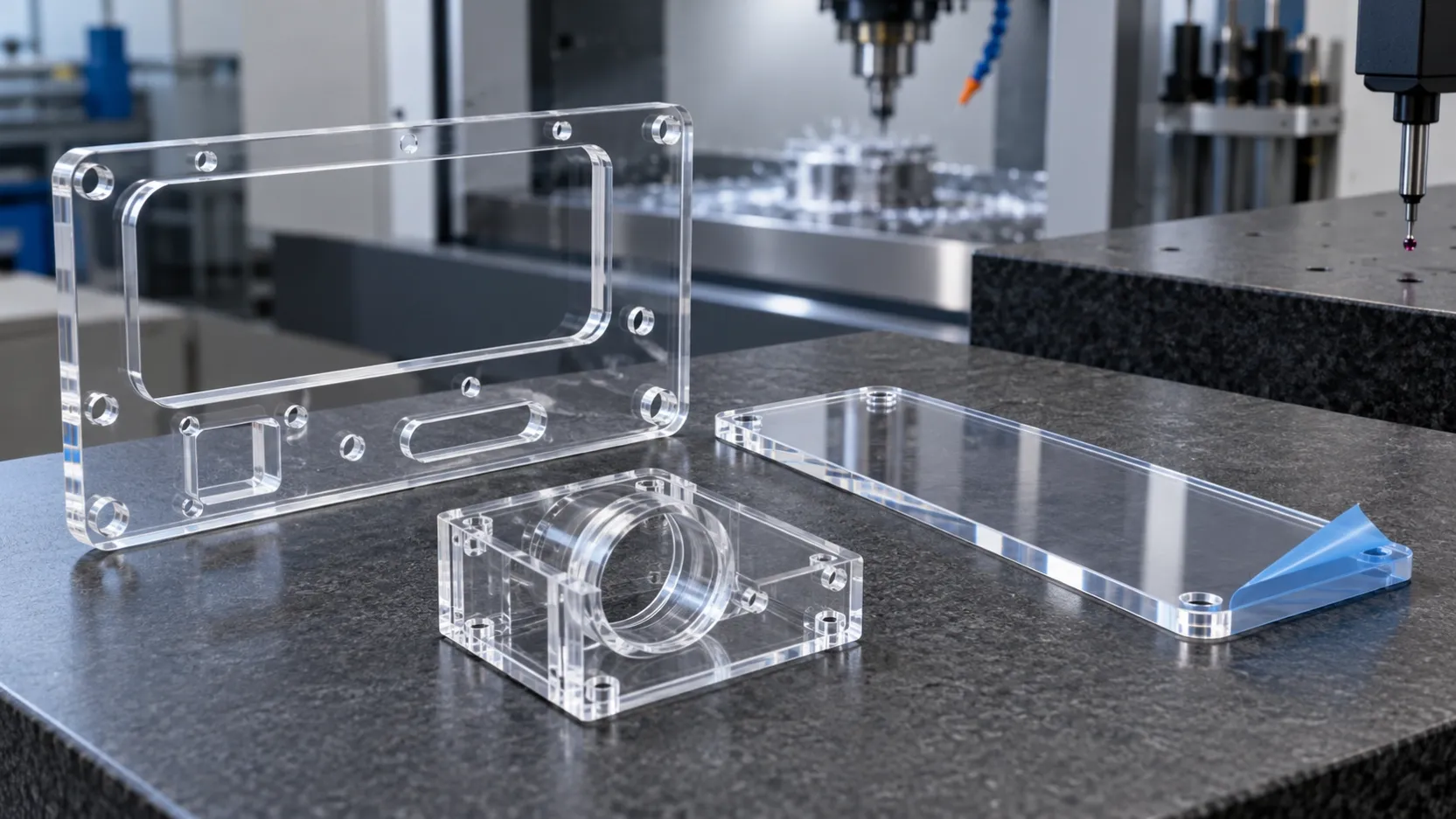
Custom CNC Machined Acrylic & PMMA Parts Manufacturer
Custom CNC machined acrylic and PMMA parts for windows, panels, covers and optical equipment, with grade review, crack prevention, edge finishing, appearance inspection and protective packaging.
The Clear Panel Looked Premium—Until Light Revealed Every Tool Mark
Acrylic parts often appear simple on a drawing: a transparent window, a polished cover or a flat instrument panel. The difficulty becomes visible only after assembly. Light catches a milky edge, a countersink develops a small crack, or a display window shows distortion that was not obvious during dimensional inspection. For the manufacturer, these are not minor cosmetic issues. They can delay product approval, create rework and weaken the finished equipment’s perceived quality.
Zync Precision manufactures custom CNC machined acrylic and PMMA parts from customer drawings. We review optical zones, stock grade, thickness tolerance, stress concentration, edge finish, bonding, protective film and packaging before quotation so the delivered part performs in the real assembly.
When to Choose Acrylic Instead of Polycarbonate
Acrylic is commonly selected when optical clarity, surface hardness, color consistency and a premium appearance are more important than extreme impact resistance. Polycarbonate generally offers higher toughness, while acrylic can provide better clarity and scratch resistance. The correct choice depends on impact risk, operating temperature, UV exposure, cleaning chemicals, flame requirements and whether the part carries structural load.
If your team is deciding between PMMA and polycarbonate, share the installed environment and the failure mode you most need to avoid. A material recommendation based only on price can create a much more expensive field problem.
Specify the Exact Acrylic Grade
Cast acrylic, extruded acrylic, optical-grade PMMA, UV-resistant material, antistatic grades and colored acrylic are not interchangeable. Cast sheet often machines differently from extruded sheet and may offer better dimensional stability for thicker, high-quality components. Your RFQ should state the required grade, color, light transmission, thickness, approved brand or standard, compliance requirements and whether equivalents are acceptable.
For transparent parts, define which areas are optical viewing zones, general cosmetic zones and non-visible functional areas. This prevents unnecessary polishing cost while protecting the surfaces customers actually see.
Critical Risks in CNC Machined Acrylic Parts
Cracking Around Holes and Fasteners
Small edge distances, sharp countersinks, tight press fits and excessive screw torque can initiate cracks. Hole clearance, washer size, insert choice, gasket compression and assembly torque should be considered together. A panel can be dimensionally correct and still fail during final tightening.
Heat, Chipping and Edge Damage
Incorrect cutting conditions can create heat, smearing, chips or a rough white edge. Tool selection, chip evacuation, support and controlled engagement are important for clean features, especially around thin walls, narrow slots and small holes.
Stress Crazing After Cleaning or Bonding
Acrylic can develop fine cracks when stressed material contacts incompatible solvents, cleaners, adhesives or threadlockers. Identify all chemicals used in machining, assembly, cleaning and service. Bonded joints should be prototyped using the intended adhesive and process.
Optical Distortion and Surface Defects
A transparent part may meet size requirements but still distort a display, sensor or inspection view. Flatness, surface waviness, viewing angle, scratch limits and acceptable tool marks must be defined where optical performance matters.
Edge Finishing Options
Not every edge needs the same finish. A hidden mounting edge may require only safe deburring, while a visible light-transmitting edge may need fine machining and polishing. Mechanical polishing, vapor or flame-style finishing can affect geometry and introduce heat or stress, so the method should be selected around the application rather than appearance alone.
State whether the priority is visual clarity, a glossy decorative edge, controlled dimensions or reliable bonding. When tolerances are tight, finishing allowance must be planned before machining.
Typical Custom Acrylic Components
- Machine windows, safety covers and inspection panels
- Instrument faces, control-panel overlays and display windows
- Lighting guides, sensor windows and optical fixtures
- Transparent housings, lids and laboratory equipment components
- Retail displays, branded equipment panels and presentation parts
- Prototype enclosures and low-volume replacement components
Inspection Must Include Appearance
Key dimensional checks may include hole-pattern position, overall flatness, thickness, mounting datum relationships, gasket surfaces and connector cutouts. Appearance inspection should define lighting, viewing distance, cosmetic zones, scratch criteria, edge quality and the condition of protective film.
When requested during RFQ review, dimensional reports, material certificates and lot traceability can be provided against agreed requirements. Clean handling and separated packaging help prevent rubbing, fingerprints and shipping damage.
Prototype the Installed Assembly
A useful prototype should be installed with the intended screws, washers, inserts, gaskets, adhesives and cleaners. Check fastener torque, panel bow, edge clearance, vibration, temperature, UV exposure and optical performance under real lighting. Discovering a stress or visibility problem during prototype validation is far less expensive than correcting a production batch.
What to Include in Your Acrylic Machining RFQ
- 3D CAD model and dimensioned 2D drawing with revision level
- Exact acrylic or PMMA grade, color, thickness and approved supplier
- Optical, cosmetic and hidden surface zones
- Critical dimensions, flatness, hole position and viewing requirements
- Edge-finish and polishing requirements
- Fastener, insert, gasket, adhesive and assembly-torque information
- UV, temperature, impact and chemical exposure
- Inspection reports, certificates, protective film and packaging needs
- Prototype quantity, annual demand, delivery date and destination
Request an Acrylic Manufacturability Review
Send your drawing package to Zync Precision for a practical review of material selection, crack risk, optical zones, fastening, edge finishing, inspection and packaging. The objective is a transparent part that remains clear, intact and visually consistent after assembly—not merely one that matches the CAD file before installation.