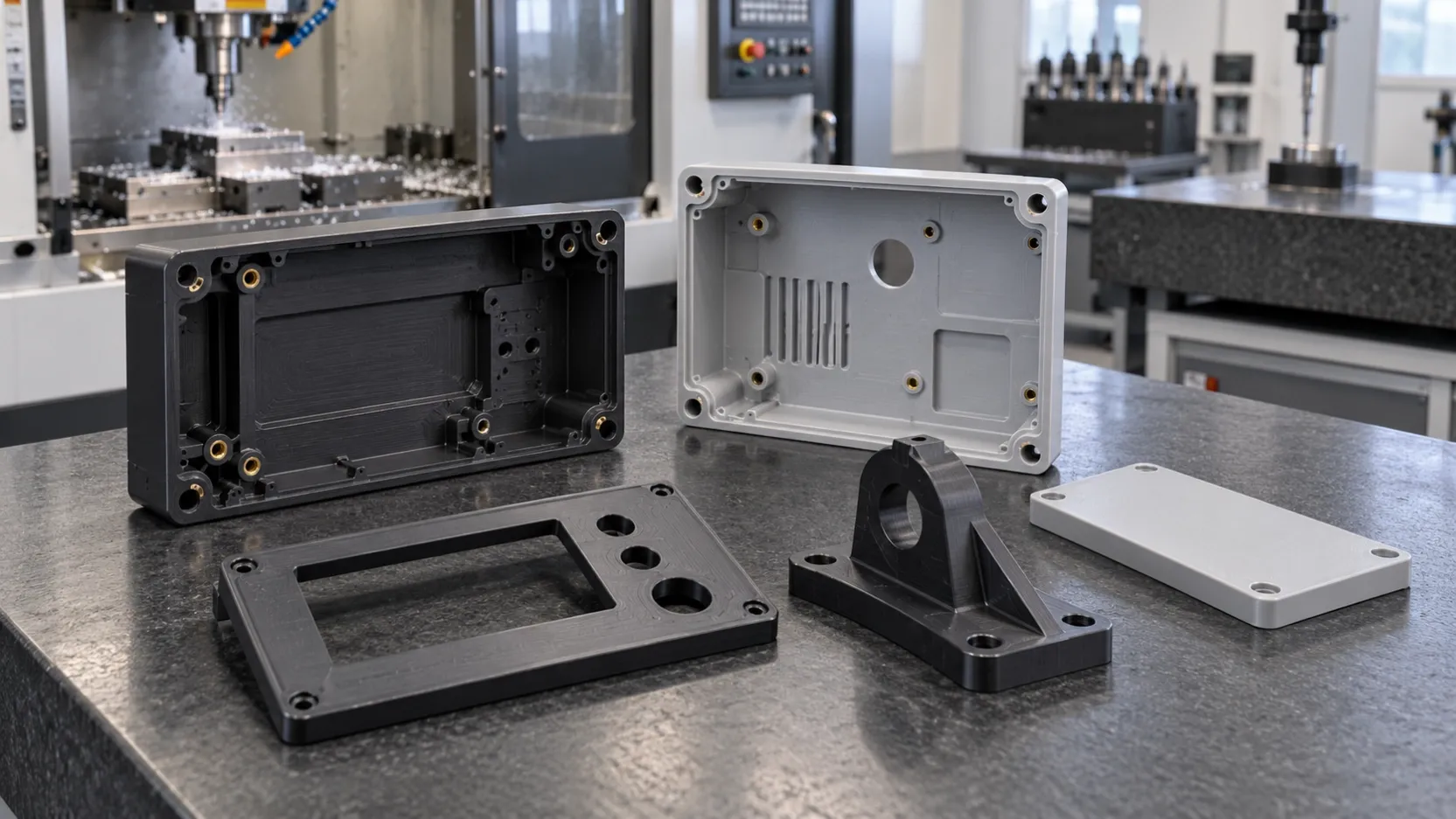
Custom CNC Machined ABS Parts Manufacturer
Custom CNC machined ABS parts for housings, covers, panels and industrial equipment, with grade review, distortion control, insert planning, dimensional inspection and material traceability.
The ABS Housing Passed Inspection—Then the Assembly Would Not Close
The dimensions on the report were within tolerance, but the molded-equipment prototype still failed on the production line. One corner lifted after machining, a snap feature turned white during assembly, and the threaded inserts pulled out when the screws were tightened. For the buyer, the problem was not the price of one plastic housing. It was the delayed validation build and the uncertainty about whether the next batch would behave the same way.
Custom CNC machined ABS parts are often selected for housings, covers, brackets, control panels and functional prototypes because ABS is lightweight, impact resistant and economical. Reliable results, however, depend on the exact resin grade, stock condition, wall design, workholding, insert method, cosmetic requirements and inspection plan. Zync Precision reviews these factors before quotation so the part is assessed in its installed condition—not only as a CAD model.
When CNC Machining ABS Is the Right Choice
CNC machining is useful when a manufacturer needs functional prototypes before tooling, bridge production while molds are being built, low-volume replacement parts, or stable repeat orders that do not justify injection molding. It also gives engineering teams the freedom to revise hole positions, connector cutouts and mounting features without changing a mold.
Machined ABS is not automatically identical to injection-molded ABS. Extruded or compression-molded stock can have different internal stress, surface appearance and directional behavior. If the machined prototype will be used to validate an eventual molded part, identify which properties and assembly conditions must be representative.
Specify the Grade, Color and Compliance Requirement
An RFQ that says only “ABS, black” leaves important decisions unresolved. Standard, flame-retardant, UV-stabilized, antistatic and high-impact ABS grades are not interchangeable. Color, gloss, UL rating, RoHS or REACH declarations, approved manufacturer and lot certification may affect both cost and availability.
Tell us whether an equivalent grade is acceptable. If appearance matters, provide a color reference, define cosmetic surfaces and state whether minor stock variation, machining marks or gloss differences are permitted.
Common Failure Risks in Machined ABS Parts
Warping After Material Removal
Thin covers and asymmetric pockets may move as internal stress is released. Balanced roughing, suitable clamping and a planned finishing sequence help control flatness and hole position. Critical mounting faces and sealing areas should be identified on the drawing.
Cracking and Whitening Around Fasteners
Small edge distances, sharp countersinks, press fits and excessive screw torque concentrate stress. Screw clearance, washer diameter, insert design and assembly torque should be reviewed together. A part can pass dimensional inspection and still fail when the customer tightens the hardware.
Chipping, Burrs and Weak Small Features
Fine ribs, narrow slots, cross-holes and snap features require careful tooling and support. Edge-break requirements should distinguish functional edges from cosmetic edges. Critical internal burrs or loose particles must be called out before production.
Chemical Stress Cracking
Some cleaners, adhesives, threadlockers, oils and solvents can attack ABS. Share the chemicals used during assembly, cleaning and service. Compatibility should be reviewed before choosing a bonding or marking process.
Typical Custom ABS Components
- Electronic housings, instrument covers and control enclosures
- Machine guards, access panels and equipment bezels
- Sensor mounts, cable guides and connector plates
- Jigs, fixtures and production-line change parts
- Prototype automotive and appliance components
- Low-volume replacement parts for legacy equipment
Design Details That Reduce Cost and Risk
Use practical internal radii instead of sharp corners, keep wall thickness as balanced as possible, and avoid unnecessarily deep narrow pockets. Specify tight tolerances only where they control fit, sealing, alignment or motion. When threaded inserts are required, identify insert type, installation method, pull-out requirement and mating screw.
For housings, supply the mating component or assembly drawing when possible. A short review of connector clearance, gasket compression, screw access and cable routing often prevents more cost than a small reduction in unit price.
Inspection Should Match the Assembly
Typical priorities include overall flatness, hole-pattern position, boss dimensions, connector cutouts, insert location and critical mating surfaces. Cosmetic zones, scratch limits, color expectations and protective-film requirements should be documented separately from dimensional tolerances.
When requested at RFQ stage, inspection reports, material certificates and lot traceability can be linked to the order. Parts can be individually protected or separated to reduce rubbing during international transport.
What to Include in Your ABS Machining RFQ
- 3D CAD file and dimensioned 2D drawing with revision level
- Exact ABS grade, color, compliance and approved supplier
- Prototype quantity, annual demand and target delivery date
- Critical dimensions, fits, geometric tolerances and cosmetic zones
- Threads, inserts, fasteners and intended assembly torque
- Operating temperature, UV exposure and chemical contact
- Inspection reports, certificates, traceability and packaging needs
- Photos or drawings of the mating assembly when available
Request an ABS Manufacturability Review
Send your drawing package to Zync Precision for a practical review of material grade, deformation risk, fastening, cosmetic requirements, inspection and packaging. We will quote against the conditions that matter to your assembly, helping you move from prototype to repeat production with fewer surprises.