Oct 30, 2026CNC Machining Guides
Titanium CNC Machining: Grades, Machinability, Tolerances and Cost
A buyer's guide to titanium CNC machining: choosing Grade 2, 5, 23 or 9, why titanium is hard to machine, realistic tolerances and finish, cost drivers, and what to put in the RFQ.
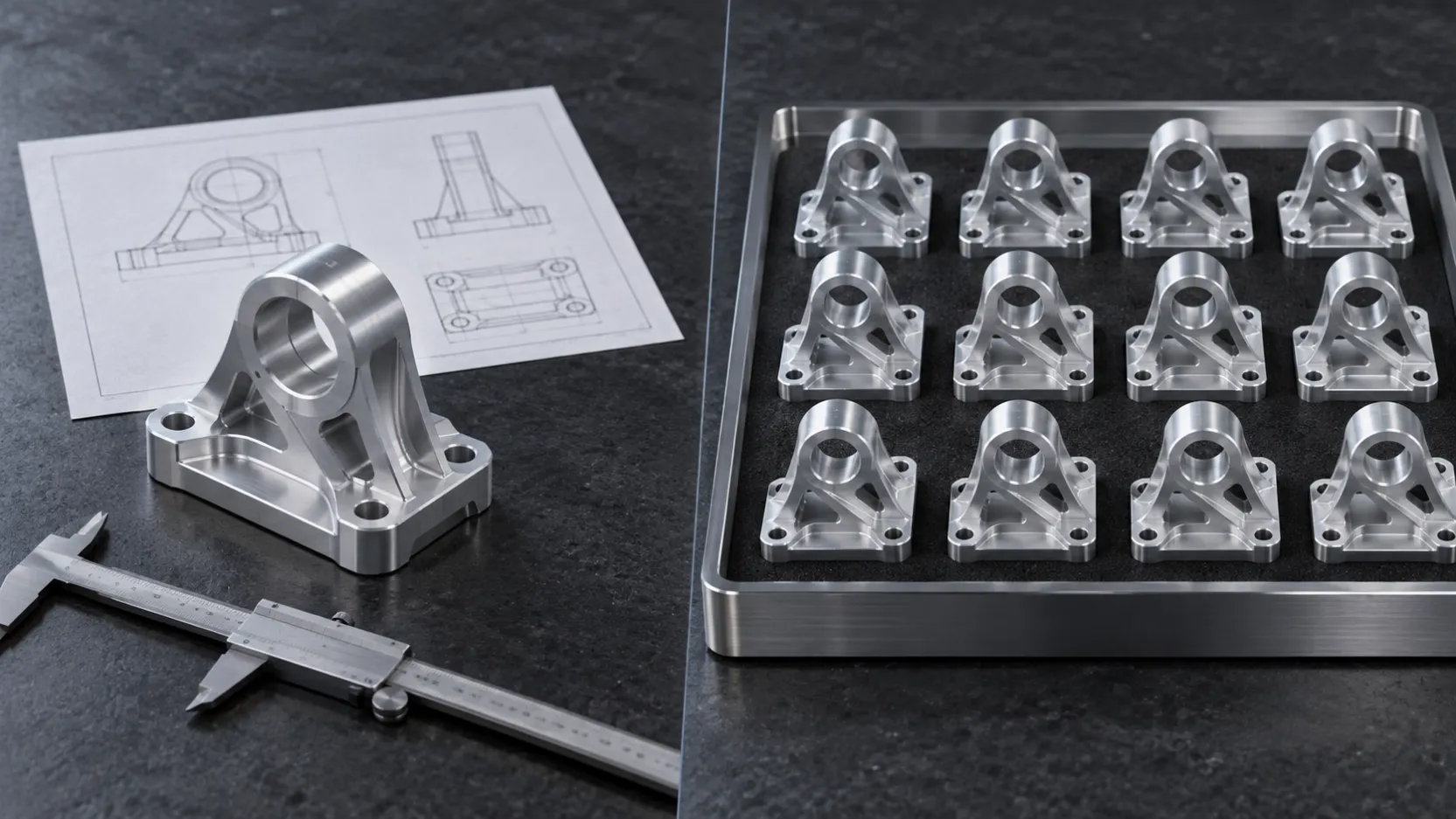
Titanium is the material buyers ask for when aluminum is not strong enough, stainless steel is not corrosion resistant enough, and the weight budget is already tight. It is also the material that produces the most unexpected quotes, because titanium is not simply a harder version of aluminum. It machines differently, wears tools differently, and punishes small mistakes in setup and coolant delivery.
This guide is written for buyers and engineers who need custom titanium parts machined from a drawing or CAD file. It covers the grades used in CNC machining, what makes titanium difficult, how to set realistic tolerances and surface finishes, which design features drive cost, what to put on the drawing and RFQ, and which quality documents to request.
The Short Answer
Specify the titanium grade and condition, not just "titanium." Grade 5 (Ti-6Al-4V) is the default for high-strength industrial and aerospace parts. Grade 2 commercially pure titanium is used when corrosion resistance and formability matter more than strength. Grade 23 (Ti-6Al-4V ELI) is used for medical implants and other applications that require lower interstitial content. Expect tighter process control, slower cutting, more tool wear, and higher cost than aluminum or stainless steel. Design for rigidity, avoid unsupported thin walls, specify tolerances only where they matter, and ask for the mill certificate and heat lot with the parts.
Why Titanium Is Different from Aluminum and Stainless Steel
Titanium has an excellent strength-to-weight ratio and a stable, protective oxide layer. It resists chlorides, seawater, many acids, and body fluids. It is biocompatible and non-magnetic. These properties make it valuable in aerospace, medical, chemical processing, marine, and high-performance automotive work.
The same properties make it harder to machine. Titanium has low thermal conductivity, so heat concentrates at the cutting edge instead of flowing into the chip and the workpiece. It work-hardens at the surface, which means a dull tool or a tool that rubs instead of cuts can make the next pass harder. It galls and welds to cutting tools under pressure. Its elastic modulus is lower than steel, so slender parts deflect and spring back during machining. The result is a process that demands sharp tools, rigid setups, generous coolant, and conservative parameters.
Common Titanium Grades for CNC Machining
The grade determines strength, corrosion resistance, weldability, and cost. The drawing should name the grade and the material specification.
Grade 1, 2, 3, and 4: commercially pure titanium
Commercially pure grades are unalloyed titanium with different oxygen and impurity levels. Grade 2 is the most common. It offers excellent corrosion resistance, good formability, and moderate strength. It is used for chemical equipment, marine hardware, heat exchangers, and components that need corrosion resistance more than high strength. Grade 1 is softer and more formable. Grade 4 is the strongest of the commercially pure grades.
Grade 5: Ti-6Al-4V
Grade 5 is the workhorse titanium alloy. It contains 6 percent aluminum and 4 percent vanadium, and it is significantly stronger than commercially pure titanium. It is used for aerospace structures, medical instruments, high-performance automotive parts, and industrial components that need high strength at low weight. Grade 5 is harder to machine than Grade 2 and is more sensitive to tool wear and heat.
Grade 23: Ti-6Al-4V ELI
Grade 23 is the extra-low-interstitial version of Grade 5. It has lower oxygen, nitrogen, carbon, and iron content, which improves ductility and fracture toughness. It is commonly specified for medical implants and surgical instruments. The machining behavior is similar to Grade 5, but the material certification and traceability requirements are usually stricter.
Grade 9: Ti-3Al-2.5V
Grade 9 is a lower-strength alloy used for tubing, bicycle frames, and some aerospace components. It offers a useful balance of strength, formability, and weight. It is less common in general CNC machining than Grade 5, but it appears in applications where cold formability or weldability matters.
Beta and near-beta alloys
Beta alloys such as Ti-15-3, Beta 21S, and Ti-10-2-3 offer higher strength and better formability in some conditions. They are more specialized, less available, and more expensive. They should only be specified when the application genuinely requires their properties.
What Makes Titanium Hard to Machine
Titanium's difficulties are predictable, which means they can be managed.
Low thermal conductivity
Heat generated at the cutting edge does not leave with the chip quickly. It builds up in the tool and the workpiece. High-pressure coolant, through-tool coolant where available, and a generous flood are more important than on aluminum. Without heat control, the tool edge breaks down, the surface finish suffers, and dimensional accuracy drifts.
Work hardening
Titanium work-hardens when the tool rubs instead of cutting. A sharp edge, a positive rake, and a feed rate that stays above the work-hardened layer are essential. Light passes that rub the surface can make the next pass harder. If a tool starts to dull, changing it early is usually cheaper than forcing it through the part.
Galling and chip welding
Titanium can weld to the tool under pressure and heat. Sharp tools, appropriate coatings, and good coolant flow reduce the risk. In some operations, a dedicated titanium machining strategy and tool geometry are needed. Tapping is particularly sensitive; thread milling or a controlled tapping process may be more reliable than conventional tapping.
Low rigidity and springback
Titanium's elastic modulus is lower than steel, so slender parts deflect under cutting force. The part can spring back after the tool passes, leaving a taper or an out-of-tolerance feature. Support the workpiece, use light radial engagements, and plan the finishing passes so that the final cut removes a small, consistent amount of material.
Tool wear
Titanium wears tools faster than aluminum and many steels. Tool life is a real cost driver. A shop that quotes titanium like aluminum will either lose money or deliver poor quality. The quote should reflect the tooling strategy, the coolant, and the inspection time.
Tolerances and Surface Finish
Titanium can be machined to tight tolerances, but the achievable tolerance depends on the feature, the geometry, the wall thickness, the setup, and the inspection method.
A general machining tolerance of ±0.05 mm is common for many features. Precision features can be held to ±0.01 mm, and selected features can be tighter when the drawing, process, and inspection plan support it. Do not assume that every feature can be held to the tightest tolerance on the drawing. Specify tight tolerances only on the features that affect fit, function, or assembly.
Surface finish also depends on the operation. Turning and milling can produce a range of Ra values depending on the tool, the feed, the speed, and the stability of the setup. A smoother finish may require a separate finishing pass, a different tool, or a secondary operation. If the drawing calls for a very smooth surface, say whether it is functional or cosmetic, and whether it applies to the whole part or only to specific faces.
Inspection of titanium parts has its own challenges. Burrs, smeared material, and tool marks can affect measurements. CMM programming and fixturing should account for the part's flexibility. For thin or slender parts, inspect in a free state or in a simulated assembly condition, and state the inspection condition on the drawing.
Design Rules That Reduce Titanium Cost
Titanium is expensive before the spindle starts. Design choices that reduce machining time and scrap have a large effect on the final price.
Avoid unsupported thin walls
Thin walls deflect and vibrate. If a thin wall is required, design it with a uniform thickness, add support where possible, and expect slower cutting and more inspection. A wall that is thin for no functional reason is a cost driver.
Use generous internal radii
Sharp internal corners require small tools, slow cutting, and frequent tool changes. A larger corner radius allows a larger cutter and a more stable process. Where a sharp corner is functionally necessary, consider whether the feature can be produced by another process or whether the corner can be relieved.
Limit deep, narrow pockets
Deep pockets with small corner radii are difficult in any material and especially in titanium. The tool has to reach deep with a small diameter, which limits rigidity and coolant delivery. If the pocket is necessary, discuss the depth-to-diameter ratio and the corner radius with the machining supplier before finalizing the drawing.
Consider the axis of the part
Five-axis machining can reduce the number of setups and improve access to features. It can also increase the hourly rate. The right choice depends on the part geometry and the quantity. A part that looks expensive on a three-axis machine may be cheaper on a five-axis machine with fewer setups, or the reverse.
Avoid unnecessary surface finish requirements
A cosmetic finish on a non-visible surface adds cost without adding function. Specify the finish where it matters, and use a general finish elsewhere. If a surface needs to be polished, masked, or protected, say so on the drawing.
What to Put on the Drawing and RFQ
A titanium RFQ should remove ambiguity before the quote is prepared.
State the titanium grade and the material specification. For Grade 5, that may be an ASTM or AMS specification; for medical Grade 23, the relevant ASTM specification may apply. State the condition, such as annealed, and any heat treatment or stress relief requirement.
State the tolerances by feature, not as a single block tolerance for the whole part. Identify the critical dimensions, the datum scheme, and the inspection method. If the part is thin or flexible, state the inspection condition.
State the surface finish by Ra value and by location. Distinguish functional surfaces from cosmetic surfaces. If the part will be anodized, passivated, polished, or coated, say so, because the finishing operation may affect dimensions and inspection.
State the quantity, the delivery destination, and the required documentation. For titanium, the mill certificate and heat lot traceability are usually important. If the application requires first article inspection, a CMM report, or a certificate of conformity, list it in the RFQ. If the application is medical or aerospace, state the quality system requirement and confirm the supplier's certificate scope before the order is placed.
Quality Documents to Request
Titanium is often used in applications where a material mix-up or a missing certificate is a serious problem. The documentation package should match the risk.
At a minimum, request the mill certificate for the titanium lot, the heat number, and traceability from the raw material to the finished parts. Request the inspection report for the critical dimensions, including the sampling plan and the measurement method. If the part is for a regulated industry, request a certificate of conformity, a first article inspection report, and any process certifications that the drawing or contract requires.
Do not assume that a supplier's ISO 9001 certificate covers AS9100 or ISO 13485 requirements. These are different quality system standards with different audit scopes. If your application requires them, ask for the certificate and confirm the scope covers the site and the product type.
Applications and Material Selection
Titanium is selected when the combination of strength, weight, and corrosion resistance justifies the cost.
In aerospace, titanium is used for structural brackets, fasteners, engine components, and hydraulic parts. In medical, it is used for implants, instruments, and surgical devices. In chemical processing, it is used for heat exchangers, reactor components, and piping where chlorides or aggressive media attack other metals. In marine, it is used for seawater-exposed hardware. In motorsport and high-performance automotive, it is used for lightweight, high-strength components.
Grade 2 is often enough for corrosion-driven applications. Grade 5 is the default when strength and weight matter. Grade 23 is specified when medical or low-interstitial requirements apply. The right choice is the lowest-cost grade that meets the functional requirement, not the highest-strength grade available.
FAQ
Is titanium harder to machine than stainless steel?
In many operations, yes. Titanium's low thermal conductivity, work hardening, and galling tendency make it more demanding on tooling and process control. It can be machined reliably, but the parameters and tooling must be designed for titanium.
Can titanium parts be held to ±0.01 mm?
Many features can, but it depends on the geometry, the wall thickness, the setup, and the inspection method. A blanket tolerance of ±0.01 mm on every feature is usually unnecessary and expensive. Specify tight tolerances only where they affect function.
Is Grade 5 always better than Grade 2?
No. Grade 5 is stronger, but Grade 2 is more corrosion resistant in some environments, more formable, and less expensive. The right grade depends on the application. Using Grade 5 where Grade 2 is sufficient adds cost without adding value.
Why is titanium machining more expensive than aluminum?
The material costs more, the cutting speed is lower, the tool wear is higher, and the process requires more coolant and process control. The quote reflects all of these factors, not just the raw material price.
Can titanium parts be anodized or coated?
Yes. Titanium can be anodized, passivated, and coated, but the process affects dimensions and surface appearance. If the part will be finished, include the finish requirement in the RFQ and discuss the dimensional impact with the supplier before machining.
Choosing a Titanium Machining Supplier
A titanium supplier should be able to explain the grade, the material certification, the machining strategy, the inspection plan, and the finishing options. Ask how the supplier controls heat, tool wear, and work hardening. Ask for the mill certificate and a sample inspection report. If the application is regulated, ask for the relevant quality system certificate and confirm its scope.
Zync Precision is an ISO 9001-certified manufacturer of custom CNC machined parts for medical, aerospace, consumer electronics, and automotive applications. Our engineering team reviews drawings, materials, tolerances, surface finishes, and delivery requirements, and responds to quote requests within 24 hours. If you are sourcing titanium components, send your drawing, grade, quantity, tolerances, finish, and destination, and include any quality documentation requirements in the request.
Request a CNC machining quote and let us review your titanium project.