CNC Machining Guides
POM vs PEEK: Which Plastic Should You Specify?
POM or PEEK? Compare strength, temperature, chemical resistance, wear, machinability, cost and design rules—and learn which engineering plastic to specify for CNC parts.
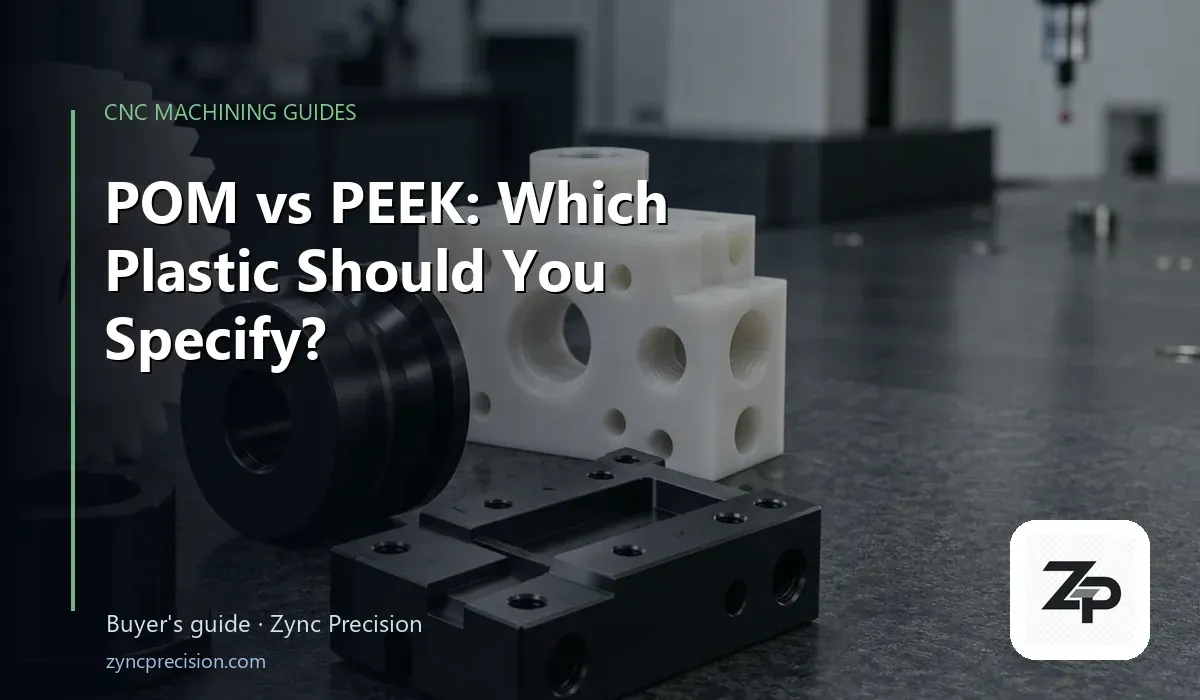
A buyer chose POM for a guide block because it was cheaper and easy to machine. The part ran at a higher temperature than expected and wore out in service. Another buyer chose PEEK for a simple cover because it was "the best plastic." The cover did not need the temperature or chemical resistance, and the part cost several times more than it should have.
POM and PEEK are both engineering plastics, but they are built for different jobs. POM is the practical choice for many mechanical parts: gears, bushings, rollers, guides, and fluid components. PEEK is the high-performance choice for high temperature, aggressive chemicals, wear, and critical applications. The right choice depends on what your part must survive, not on which plastic sounds more advanced.
This guide is written for design engineers and buyers who need to choose between POM and PEEK for CNC machined parts. It covers temperature, chemical resistance, strength, wear, moisture, machinability, cost, and the questions you should ask before you specify the material.
The Short Answer
Choose POM when your part needs good mechanical properties, low friction, easy machining, and moderate temperature, and when the chemical environment is compatible. Choose PEEK when your part must handle high temperature, aggressive chemicals, wear, or a critical application, and the higher cost is justified. Specify the grade, the color, any filler, and the condition. If you are not sure, tell the supplier what the part must survive—temperature, chemical, load, speed, cleaning—and ask for a recommendation.
What POM and PEEK Are
POM is polyoxymethylene, also known as acetal. It is a semi-crystalline engineering plastic with good strength, stiffness, fatigue resistance, and low friction. It is available as homopolymer and copolymer. POM is widely used for gears, bushings, rollers, guides, valve components, and fittings.
PEEK is polyetheretherketone. It is a high-performance semi-crystalline plastic with high strength, high temperature resistance, chemical resistance, and wear resistance. It is used in aerospace, medical, semiconductor, oil and gas, and other demanding applications. PEEK is more expensive and more specialized than POM.
The names are not interchangeable. A drawing that says "plastic" or "engineering plastic" is not a specification. The grade, the filler, the color, and the condition should be stated.
Temperature: The First Decision
Temperature is often the first reason to choose PEEK over POM.
POM has a moderate continuous service temperature. The exact limit depends on the grade, the load, and the time at temperature. Above that range, POM can soften, creep, or degrade. If your part runs hot, POM may not be the right choice.
PEEK has a much higher continuous service temperature. It retains strength and stiffness at temperatures where POM would fail. It is used in applications that see high temperature in service, in cleaning, or in sterilization.
Do not choose the material by the maximum temperature on a datasheet alone. The load, the time, the cycling, and the environment matter. A part that sees a short excursion is different from a part that runs continuously at temperature.
Chemical Resistance: What Is Your Part Exposed To?
POM has good resistance to many fuels, solvents, and mild chemicals. It is not resistant to strong acids, strong oxidizers, or some aggressive media. If your part sees a strong chemical, check the compatibility before you choose POM.
PEEK has broad chemical resistance, but it is not immune to everything. Some concentrated acids and specific chemicals can attack it. The concentration, the temperature, and the exposure time matter.
Do not assume that PEEK is compatible with every chemical because it is "high performance." Check the actual medium, the temperature, and the cleaning chemistry. If the application is critical, ask the material supplier for compatibility data.
Strength, Stiffness and Wear
POM has good strength, stiffness, and fatigue resistance for a general engineering plastic. It has low friction and good wear behavior in many dry-running and lubricated applications. It is a good choice for gears, bushings, and sliding parts.
PEEK has higher strength and stiffness, and it retains them at higher temperature. It has good wear resistance, especially in filled grades. Glass-filled and carbon-filled PEEK can be used for higher loads and higher stiffness, but the fillers can be abrasive to the cutting tool and to the mating surface.
The right choice depends on the load, the speed, the mating material, the lubrication, and the temperature. A POM gear may be perfect for a low-load application; a PEEK gear may be necessary for a high-temperature or high-load application.
Moisture and Dimensional Stability
Both plastics absorb a small amount of moisture, and both can change dimension after machining. The change is smaller than nylon, but it can matter for tight fits.
POM absorbs a small amount of moisture and can change dimension slightly. For a tight bore or a press fit, the part should be conditioned and measured under the agreed condition.
PEEK has low moisture absorption and good dimensional stability, but it is not zero. The grade, the filler, and the thermal history affect the result.
If your part has a tight fit, do not rely on the nominal dimension alone. Ask the supplier how the part will be conditioned and measured, and specify the inspection condition.
Machinability and Stress
POM is one of the easiest plastics to machine. It cuts cleanly, holds good tolerances, and produces a good surface finish. It can still produce soft burrs at cross-holes and edges, and it can release internal stress when a lot of material is removed.
PEEK is harder and more abrasive, especially in filled grades. It requires sharp tools, good chip evacuation, and a process designed for the material. It can also release internal stress, and annealing may be required for critical parts.
If your part has thin walls, tight tolerances, or a lot of material removal, discuss the machining sequence with the supplier. The same design that works in POM may need a different strategy in PEEK.
Cost: Where the Money Goes
PEEK is significantly more expensive than POM, both as a material and as a machining cost. The material price, the tool wear, the annealing, and the inspection add up.
POM is cost-effective for many parts. The material is widely available, the machining is fast, and the tolerances are achievable. For a part that does not need high temperature or aggressive chemical resistance, POM is often the lower total cost choice.
The right comparison is the total cost of the finished part, not the price per kilogram. A PEEK part that fails in service is not cheaper. A POM part that is over-specified for the application is not better.
Applications: Where Each Plastic Fits
POM is common in automation, motion control, fluid handling, automotive, and consumer products. Typical parts include gears, bushings, rollers, guides, wear pads, valve components, manifolds, and housings.
PEEK is common in aerospace, medical, semiconductor, oil and gas, and high-performance industrial applications. Typical parts include seals, bearings, bushings, wear rings, insulators, valve components, and implant or instrument components.
The application should drive the choice. A general guide block does not need PEEK. A high-temperature seal may not survive in POM.
What This Means for Your Part
If your part is a dry-running gear, a bushing, a roller, or a guide at room temperature, POM is often the practical choice. It machines well, wears well, and costs less.
If your part is a seal, a bearing, an insulator, or a wear ring in a hot or aggressive environment, PEEK is often the safer choice. The higher cost may be justified by the service life.
If your part is a cover, a bracket, or a housing that does not carry a load or see aggressive chemicals, POM may be enough. PEEK may be overkill.
If your part has a tight fit and a thin wall, both materials need a controlled machining and inspection condition. The difference is the temperature and the chemical resistance, not the need for good process control.
The best way to choose is to describe the job, not the material. Tell the supplier what the part must survive, and let the material follow.
A Decision Checklist
Ask these questions before you choose.
What is the service temperature, including excursions and cleaning? What chemicals or cleaning agents will the part see? What is the load, the speed, and the mating material? Is the part dry-running or lubricated? How tight is the fit, and how will it be measured? Does the application require a specific grade, filler, color, or regulatory compliance? What is the cost target and the quantity?
If the answers point to moderate temperature and general mechanical duty, POM is often the starting point. If they point to high temperature, aggressive chemicals, or high wear, PEEK may be required.
Common Buyer Mistakes
The first mistake is choosing by price alone. The cheapest material can be the most expensive if the part fails in service.
The second mistake is over-specifying PEEK for a part that does not need it. PEEK is excellent, but it is not free. A POM part may do the job at a fraction of the cost.
The third mistake is leaving the grade and filler off the drawing. "POM" and "PEEK" are families, not specifications. The grade, the filler, the color, and the condition matter.
The fourth mistake is ignoring moisture and stress. A tight fit that works on the bench may change after the part reaches equilibrium or after annealing. Specify the conditioning and the inspection condition.
What to Put in the RFQ
State the plastic type and grade. For POM, state homopolymer or copolymer, the color, and any food-contact or regulatory requirement. For PEEK, state the grade, the filler (unfilled, glass-filled, carbon-filled), the color, and any medical or aerospace requirement.
State the application, the temperature, the chemicals, the load, the speed, and the mating material. State the critical features, the tolerance, the surface finish, and the inspection method.
State the quantity, the delivery destination, and the documentation. If the part requires annealing, conditioning, or a specific inspection condition, include it in the RFQ.
FAQ
Is PEEK always better than POM?
No. PEEK is better for high temperature, aggressive chemicals, and high wear, but it costs more and is more difficult to machine. POM is often the better choice for general mechanical parts.
Can POM handle high temperature?
POM has a moderate service temperature. Above that range, it can soften or creep. If your part runs hot, PEEK or another high-temperature plastic may be required.
Is PEEK food-safe?
It depends on the grade and the regulatory requirement. A general-purpose PEEK is not automatically food-safe. State the requirement and request the material documentation.
Which plastic is easier to machine?
POM is generally easier to machine. PEEK is harder and more abrasive, especially in filled grades. Both can be machined well with the right tools and process.
Can you machine both POM and PEEK?
Yes. Zync Precision machines POM, PEEK, and other engineering plastics from customer drawings, with material traceability and dimensional inspection.
Choosing a Plastic Machining Supplier
A plastic supplier should ask about the temperature, the chemicals, the load, and the fit before recommending a material. The supplier should be able to machine both POM and PEEK and control the annealing, the conditioning, and the inspection.
Zync Precision is an ISO 9001 and IATF 16949 certified manufacturer of custom CNC machined parts for medical, aerospace, consumer electronics, and automotive applications. We machine POM, PEEK, and other engineering plastics, with material traceability, dimensional inspection, and production support. Our engineering team reviews drawings, materials, tolerances, surface finishes, and delivery, and responds to quote requests within 24 hours. If you are choosing between POM and PEEK, send your drawing, application, temperature, chemicals, quantity, and destination.
Request a CNC machining quote and let us review your plastic project.