Oct 30, 2026CNC Machining Guides
POM / Delrin CNC Machining Guide: Tolerances, Fits, Stress and Design Rules
A buyer's guide to POM and Delrin CNC machining: homopolymer vs copolymer, moisture and stress, press fits, burr control, tolerances, design rules and RFQ requirements.
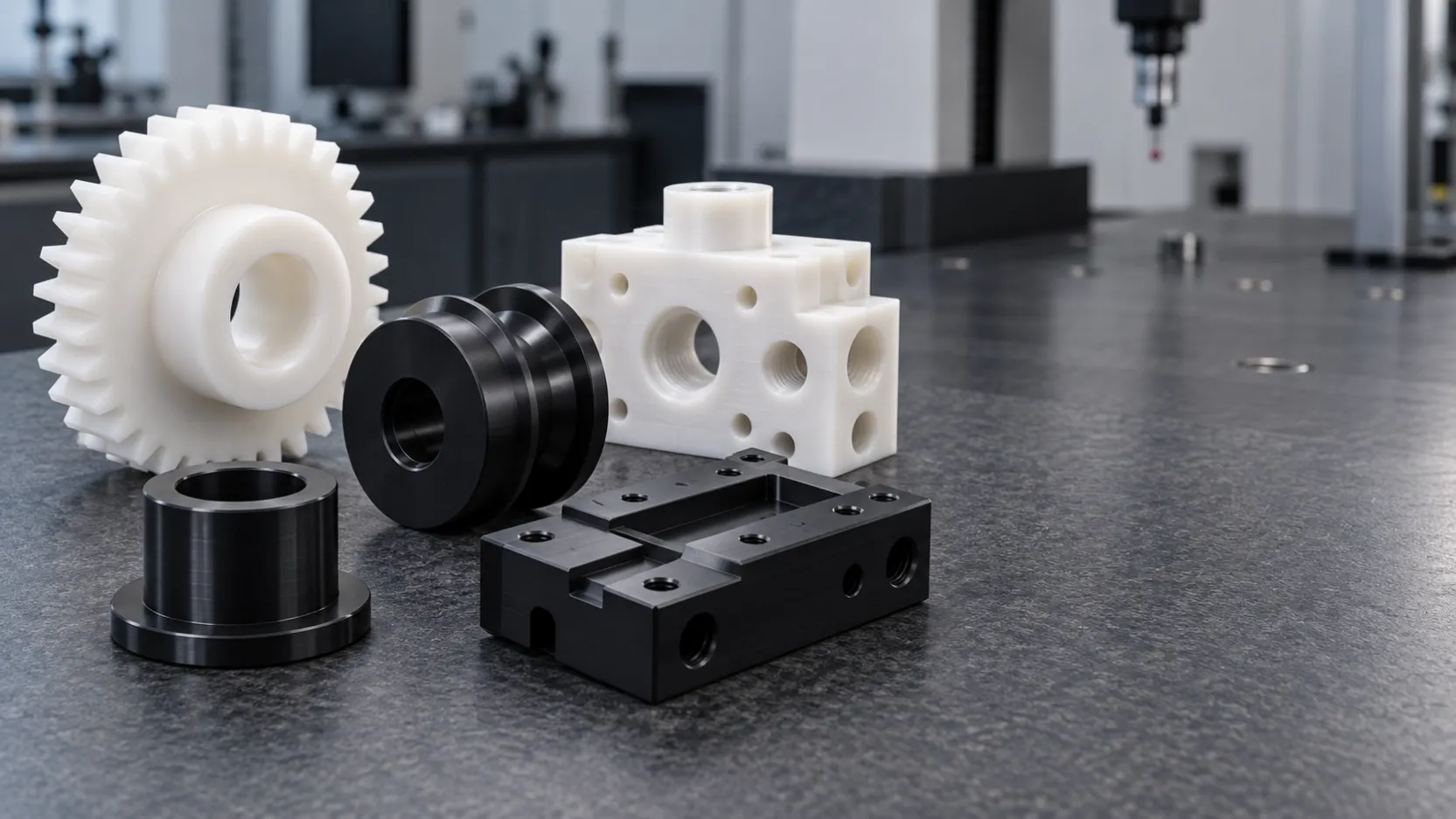
A POM gear can pass inspection and still become noisy after assembly. A guide block can measure correctly on the bench and bind when the mounting screws are tightened. A valve component can look clean and still leak because a soft burr remains at a cross-hole.
These failures are common in acetal parts because POM behaves differently from metal. It is dimensionally stable compared with many plastics, but it still moves with moisture and temperature. It machines easily, but it releases internal stress when material is removed. It holds tight tolerances on some features, but deflects on thin walls and long sections. A supplier who quotes POM like aluminum will miss these details.
This guide is written for buyers and design engineers who need custom POM or Delrin parts machined from a drawing or CAD file. It covers the material family, grade selection, moisture and stress, press fits, burr control, tolerances, design rules, and what to put in the RFQ.
The Short Answer
Specify whether you need POM homopolymer or copolymer, and name the brand only if it is truly required. State the color, any food-contact or regulatory requirement, and whether an equivalent grade is allowed. Design for balanced material removal, avoid unsupported thin walls, and expect stress relief or conditioning on critical parts. Control press fits and bearing bores with prototypes, not just nominal dimensions. Require burr control at cross-holes and sealing edges, and agree on the inspection method and temperature before production.
POM, Acetal and Delrin: Specify the Material You Actually Need
Acetal is the material family. POM is the common abbreviation for polyoxymethylene. Delrin is a well-known brand of POM homopolymer, but not every acetal sheet or rod is Delrin. The names are often used interchangeably, which creates ambiguity in RFQs.
For a buyer, the important distinction is not the brand name. It is the polymer type, the grade, the filler or lubricant package, the color, and the regulatory status. Two parts made from different acetal grades can look identical and behave differently in fatigue, chemical exposure, dimensional stability, and friction.
If the drawing says only POM, clarify the application with the supplier before material is purchased. If the part is a gear, a bearing, a wear pad, a valve component, or a food-contact part, the grade matters.
Homopolymer vs Copolymer
POM homopolymer and copolymer are both semi-crystalline acetal plastics. They share good machinability, low moisture absorption compared with nylon, good dimensional stability, and useful wear properties. They differ in the details.
Homopolymer generally offers higher strength and stiffness, better fatigue resistance, and a harder surface. It is often chosen for gears, cams, and parts that need high mechanical performance. It can be more sensitive to some chemicals and may have more centerline porosity in thick sections.
Copolymer generally offers better chemical resistance, better thermal stability, and more resistance to centerline porosity. It is often chosen for parts exposed to hot water, fuels, or aggressive media, and for thicker sections where internal porosity is a concern.
The right choice depends on the application. A gear running dry at high load may favor homopolymer. A valve component exposed to hot water may favor copolymer. A part that must meet a specific industry standard may require a particular grade. Do not let the brand name decide the material; let the application decide.
Moisture, Temperature and Dimensional Stability
POM absorbs less moisture than nylon, but it is not immune to moisture. The dimensional change is small, yet it can matter on tight fits and precision bores. A part machined dry and measured immediately may change after it reaches equilibrium with the shop or the customer's environment.
For critical parts, agree on the condition in which the part will be measured. If the drawing calls for a tight bore or a press fit, the supplier and the buyer should use the same temperature and moisture condition for inspection. In some cases, the part should be conditioned before final machining or before inspection.
Temperature also matters. POM has a relatively high coefficient of thermal expansion for a plastic, and its stiffness changes with temperature. A fit that works at 20 degrees Celsius may be too tight or too loose at 60 degrees Celsius. If the part will run hot, test the fit at the service temperature, not only at room temperature.
Internal Stress and Wall Thickness
Machining removes material and disturbs the balance of internal stress in the stock. When a large amount of material is removed from one side of a plate or ring, the part can bow, lose flatness, or change roundness. Thin walls and long sections are especially sensitive.
A good POM process uses balanced roughing, staged finishing, and sometimes intermediate rest periods. The part may be roughed, allowed to relax, and then finished. For critical parts, annealing can relieve stress before final machining. The exact sequence depends on the geometry and the stock.
Design choices also matter. A wall that is thin for no functional reason is a cost and quality risk. A rib that is too thick can create a sink mark or a stress concentration. A sharp corner concentrates stress. A uniform wall, generous radii, and a balanced section are easier to machine and more stable in service.
Press Fits, Bearing Bores and Sliding Fits
POM is often used for bushings, bearing bores, gears, and sliding guides. These features are sensitive to interference, temperature, moisture, and creep.
A press fit that is calculated only from the nominal dimensions may fail in service. POM can creep under sustained load, and its modulus changes with temperature. The interference that feels right at assembly may relax over time, or it may become too tight when the part warms up.
For critical fits, make a prototype and test the assembly under the real conditions. Measure the bore after the part has been conditioned. Check the fit at the low and high service temperatures. If the part will be pressed into a metal housing, consider the housing material and the assembly method, because the housing expands differently from the plastic.
Sliding fits have their own risks. POM has a low coefficient of friction, but it can wear or swell in some environments. The clearance must account for thermal expansion, moisture, and the surface finish of the mating part. A fit that is tight enough to prevent rattle may be too tight for smooth movement after the part warms up.
Burrs, Cross-Holes and Sealing Edges
POM produces soft burrs that can smear rather than break cleanly. A burr at a cross-hole, a sealing edge, or a sliding surface can cause a leak, a scratch, or a binding condition. The burr may not be visible in a casual inspection.
Burr control starts with the machining process. Sharp tools, climb milling, appropriate feeds, and good chip evacuation reduce burr formation. For cross-holes, the exit side is the critical side. For sealing edges, the edge condition should be specified on the drawing, not left to the supplier's default.
Deburring methods for POM include hand deburring, abrasive flow, thermal deburring, and specialized tooling. The right method depends on the feature and the risk of damaging the surface. If the part has a sealing surface, discuss the deburring method before production. A soft brush that removes a burr from a metal part may polish or round a plastic edge.
Tolerances and Surface Finish
POM can be machined to tight tolerances, but the achievable tolerance depends on the feature, the wall thickness, the setup, and the inspection method. A general tolerance of plus or minus 0.05 mm is common for many features. Precision features can be held to plus or minus 0.01 mm when the geometry and process support it. Thin walls, long sections, and flexible parts are harder.
Over-specifying tolerance is a common cost driver. A tolerance that is tighter than the function requires adds machining time, inspection time, and scrap risk. Specify tight tolerances on the features that affect fit, sealing, or motion, and use a general tolerance elsewhere.
Surface finish also matters. A smooth surface can reduce friction and wear, but a very smooth surface may be unnecessary on a non-functional face. For sealing surfaces, specify the finish and the inspection method. For cosmetic surfaces, specify whether the requirement applies to the whole part or only to visible areas.
Design Rules That Reduce POM Cost and Risk
POM is more forgiving than many engineering plastics, but good design still matters.
Use uniform wall thickness where possible. Thick sections can create internal stress and dimensional variation. Thin sections can deflect during machining and in service.
Use generous radii at internal corners. Sharp corners concentrate stress and are harder to machine cleanly. A larger radius also allows a larger cutter and a more stable process.
Avoid deep, narrow pockets and long, thin ribs. These features require small tools, slow cutting, and careful support. If they are necessary, discuss the depth-to-width ratio with the supplier before finalizing the drawing.
Design threads carefully. POM can be tapped, but thread quality depends on the material grade and the tool. For critical threads, consider thread milling or a molded insert. If the thread will be assembled and disassembled repeatedly, specify the required strength and test it.
Consider the assembly method. A snap fit, a press fit, and a threaded joint impose different loads on the plastic. A design that works in a prototype may creep or crack in production if the stress is too high. Test the assembly, not just the part.
Applications and Material Selection
POM is used in automation equipment, motion control, fluid handling, food processing, automotive, and consumer products. Common parts include gears, bushings, rollers, guides, wear pads, valve components, manifolds, and housings.
For dry-running gears and high-load wear parts, homopolymer may be the better starting point. For hot water, fuel, or chemical exposure, copolymer may be better. For food-contact applications, the grade must meet the relevant regulatory requirement; do not assume that a general-purpose POM is food-safe.
The right material is the one that meets the functional requirement at the lowest total cost. A higher-performance grade that is not needed adds cost without adding value. A lower-cost grade that fails in service costs more in the end.
What to Put in the RFQ
A clear RFQ reduces the risk of a material substitution or a fit problem.
State the polymer type and grade. If a specific brand is required, name it. If an equivalent is allowed, say so. State the color and any regulatory or food-contact requirement.
State the quantity, the drawing revision, and the critical dimensions. Identify the features that must be inspected, the tolerances that matter, and the inspection method. If the part will be measured after conditioning, state the condition.
State the surface finish and the burr requirement. For sealing edges and sliding surfaces, describe the functional requirement, not just a generic note.
State the assembly method and the service environment. If the part will be pressed into a housing, run at high temperature, or exposed to chemicals, say so. The supplier can then choose the grade and the process that fit the application.
FAQ
Is Delrin the same as POM?
Delrin is a brand of POM homopolymer. POM is the material family. A drawing that says Delrin may be interpreted as a specific brand, while a drawing that says POM may allow either homopolymer or copolymer. Clarify the requirement before quoting.
Can POM parts be machined to plus or minus 0.01 mm?
Many features can, but it depends on the geometry, the wall thickness, the setup, and the inspection method. A blanket tolerance of plus or minus 0.01 mm on every feature is usually unnecessary and expensive.
Why do POM parts change dimension after machining?
Machining removes material and releases internal stress. Moisture and temperature can also cause small dimensional changes. Balanced roughing, stress relief, conditioning, and a defined inspection condition reduce the risk.
Do POM parts need annealing?
Not every part. Annealing is used when the geometry, the material removal, or the service conditions make internal stress a risk. The supplier should recommend it based on the part and the application.
Can POM be used for food-contact parts?
Only if the specific grade meets the relevant regulatory requirement. General-purpose POM is not automatically food-safe. State the requirement in the RFQ and request the material documentation.
Choosing a POM Machining Supplier
A POM supplier should ask about the application, the grade, the fit, the assembly method, and the service environment. A supplier that only quotes the drawing may miss the reason the part fails after assembly.
Zync Precision is an ISO 9001-certified manufacturer of custom CNC machined parts for medical, aerospace, consumer electronics, and automotive applications. Our engineering team reviews drawings, materials, tolerances, surface finishes, and delivery requirements, and responds to quote requests within 24 hours. If you are sourcing POM or Delrin components, send your drawing, grade, quantity, critical fits, inspection requirements, and destination.
Request a CNC machining quote and let us review your POM project.