Oct 30, 2026CNC Machining Guides
Medical Device CNC Machining: Materials, Tolerances, Validation and Supplier Checklist
A buyer's guide to medical device CNC machining: material selection, tolerances, surface finish, cleaning, documentation, quality system scope and supplier qualification.
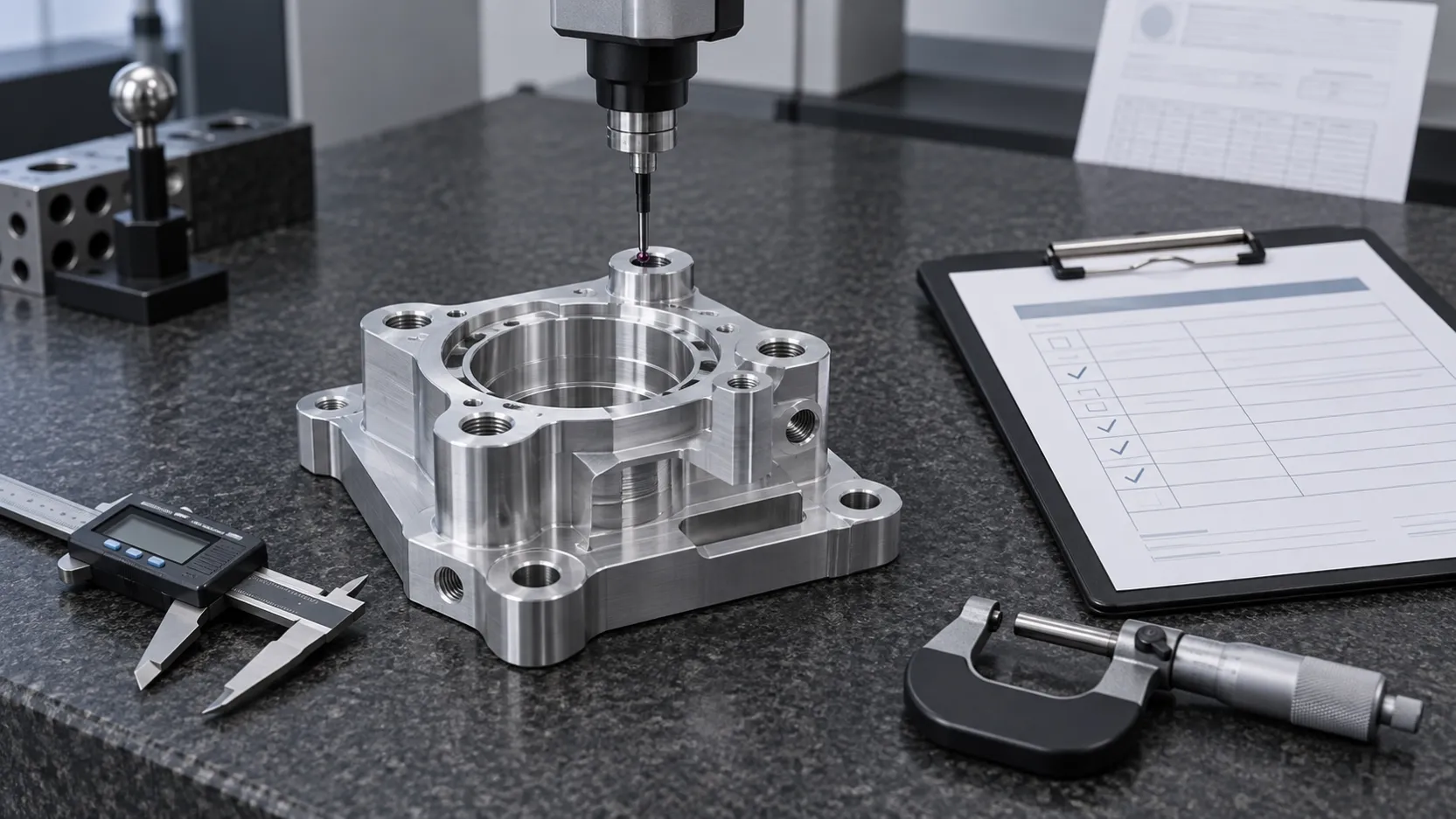
A medical component can meet every dimension on the drawing and still fail the supplier qualification. The material certificate may be missing a heat lot. The surface finish may be correct but the cleaning residue was never validated. The first article may pass, but the process change that followed was never documented.
Medical CNC machining is not only about precision. It is about evidence. The buyer needs to show that the part was made from the specified material, by a controlled process, inspected with a defined method, cleaned and packaged appropriately, and traceable from the raw material to the finished device.
This guide is written for buyers, quality engineers, and design teams sourcing custom machined components for medical devices and instruments. It covers material selection, tolerances, surface finish, cleaning, documentation, quality system expectations, and the questions to ask before placing an order.
The Short Answer
Specify the exact material grade and condition, not just the alloy family. State the tolerances by feature, the surface finish by function, and the cleaning and packaging requirements. Require the mill certificate, heat lot, certificate of conformity, first article inspection, and inspection report. Confirm the supplier's quality system scope before you assume ISO 13485 or FDA registration. Control process changes, and validate the cleaning and packaging steps that touch the patient or the sterile barrier.
What Makes Medical CNC Machining Different
Medical parts are usually small, precise, and made in low to medium volumes. The machining itself may be similar to other industries. The difference is the evidence and the risk.
A medical device component may need biocompatibility, corrosion resistance, cleanability, sterility compatibility, and traceability. The consequences of a material mix-up, a burr, a residue, or an undocumented process change are higher than in a general industrial part. The buyer's quality system may require supplier qualification, incoming inspection, and change control.
The supplier must be able to work within that system. A shop that can hold a tolerance but cannot provide a material certificate or a controlled process is not a medical supplier, even if the parts look good.
Material Selection for Medical Components
The material must meet the functional requirement and the regulatory requirement. Common materials include titanium alloys, stainless steel, and high-performance polymers.
Titanium alloys
Grade 5 Ti-6Al-4V is used for strength and corrosion resistance. Grade 23 Ti-6Al-4V ELI is the extra-low-interstitial version, used for implants and other applications that require improved ductility and fracture toughness. The material specification and the interstitial limits matter; do not accept a generic "titanium" certificate.
Titanium is biocompatible, corrosion resistant, and non-magnetic. It can be machined to tight tolerances, but it work-hardens, galls, and requires careful tooling and coolant. The material certificate should identify the grade, the heat lot, and the specification.
Stainless steel
316L stainless steel is common for instruments, housings, and components that need corrosion resistance and cleanability. The low-carbon grade reduces the risk of sensitization during welding or heat exposure. Passivation is often specified to remove free iron and improve the corrosion resistance of the machined surface.
The certificate should confirm the grade and the heat lot. If the part will be passivated, the process and the acceptance criteria should be specified.
High-performance polymers
PEEK, PPSU, and other medical-grade polymers are used for components that need chemical resistance, low weight, or electrical insulation. The grade must be suitable for the application, and the material certificate should confirm the grade and any regulatory compliance. Do not assume that a general-purpose polymer is medical-grade.
Tolerances and Inspection
Medical parts often have tight tolerances on features that affect fit, sealing, fluid flow, or assembly. The achievable tolerance depends on the feature, the material, the geometry, the setup, and the inspection method.
A general tolerance of plus or minus 0.05 mm is common for many features. Precision features can be held to plus or minus 0.01 mm, and selected features can be tighter when the drawing, process, and inspection plan support it. A blanket tolerance of plus or minus 0.005 mm on every feature is usually unnecessary and expensive.
Inspection should be planned with the part. For critical features, use a CMM with a defined datum scheme and a measurement uncertainty that is appropriate for the tolerance. For thin or flexible parts, define the inspection condition, because the part may deflect under the probe or in the fixture.
First article inspection is the baseline. The FAI report should include the drawing balloon numbers, the measured values, the specification limits, the pass or fail result, and the inspection method. For production, define the sampling plan and the reaction plan for a nonconformance.
Surface Finish, Burrs and Cleaning
Surface finish affects function, cleanability, and appearance. Specify Ra by surface and by function, not as a single note for the whole part. A sealing surface, a sliding surface, and a cosmetic surface may have different requirements.
Burrs are a critical defect in medical parts. A burr at a fluid path, a sealing edge, or a mating surface can affect performance or cleanability. Specify the burr requirement and the deburring method. For internal features, consider borescope inspection or a validated cleaning process.
Cleaning is part of the manufacturing process, not an afterthought. Machining residue, polishing compound, and handling contamination must be removed. If the part will be cleaned by the customer or at the sterile barrier, the supplier and the buyer should agree on the cleaning state, the residue limits, and the packaging. For implants and instruments, cleaning validation may be required.
Passivation of stainless steel should follow a defined process and acceptance criteria. The process should be controlled, and the results should be documented. Do not accept a visual "looks clean" inspection as the only evidence.
The Documentation Package
The documentation should match the risk of the part. A typical package includes:
A mill certificate or material certificate of analysis, with the grade, heat lot, and specification. A certificate of conformity that states the parts were made to the drawing and the purchase order. A first article inspection report for the first production lot. An inspection report for the critical dimensions, with the sampling plan and the measurement method. A process record for special processes such as passivation, cleaning, or packaging. A change control record for any change in material, process, supplier, or inspection method.
For regulated devices, the buyer may also require a quality agreement, a supplier audit, and a validation package. The exact requirements depend on the device classification and the buyer's quality system.
Quality System Expectations
ISO 9001 is a general quality management system. ISO 13485 is specific to medical devices. FDA registration and 21 CFR 820 add another layer for devices sold in the United States. These are not interchangeable.
Before you assume that a supplier can support a medical device, confirm the certificate and the scope. A supplier may be ISO 9001 certified but not ISO 13485 certified. A supplier may be ISO 13485 certified for one site or one product family but not for the process you need. Ask for the certificate, check the scope, and verify the expiry date.
If the device requires ISO 13485, the supplier's quality system should be audited or assessed against that standard. If the device requires FDA registration, confirm the supplier's registration status and the role it plays in the supply chain. Do not rely on a logo on a website.
Supplier Checklist for Medical CNC Parts
Ask these questions before placing a medical order.
Can you provide the material certificate with the grade, heat lot, and specification? Can you provide a first article inspection report with ballooned drawing numbers and measured values? What is your inspection method and measurement uncertainty for the critical features? How do you control burrs on internal features and sealing surfaces? What is your cleaning and passivation process, and how is it validated? What is your packaging and traceability system? How do you control process changes, and who approves them? What quality system certifications do you hold, and what is the scope? Have you made a part with a similar material, tolerance, and risk profile? Can you support a pilot lot and a production ramp?
The answers should be specific. A supplier that answers "yes" to everything without evidence is not a medical supplier.
From Prototype to Production
Medical projects often start with a prototype and move to a pilot lot and then to production. The handoff should be controlled.
Freeze the drawing and the specification before the pilot lot. Confirm the material grade and the supplier. Run the first article inspection and review the results with the design team. Validate the cleaning and packaging steps that will be used in production. Define the process windows and the inspection plan. Train the operators and document the training. Agree on the change control process and the notification requirements.
A pilot lot is not just a larger prototype. It is the first chance to prove that the process is repeatable and that the documentation is complete. Treat it that way.
FAQ
Does a medical part need ISO 13485?
It depends on the device, the market, and the buyer's quality system. ISO 13485 is the standard for medical device quality management. If your device requires it, confirm the supplier's certificate and scope. Do not assume that ISO 9001 is equivalent.
Can titanium medical parts be machined to plus or minus 0.01 mm?
Many features can, but it depends on the geometry, the material, the setup, and the inspection method. Specify tight tolerances only where they affect function, and define the inspection condition for thin or flexible parts.
Is passivation required for stainless steel medical parts?
Passivation is commonly specified to remove free iron and improve corrosion resistance. The requirement depends on the material, the application, and the cleaning process. Specify the standard and the acceptance criteria.
How do you control burrs in small medical features?
Burr control starts with the machining process: sharp tools, appropriate feeds, and good chip evacuation. For internal features, use borescope inspection or a validated deburring process. Specify the burr requirement on the drawing and agree on the inspection method.
Can you provide a certificate of conformity?
A certificate of conformity should state that the parts meet the drawing and the purchase order. It should be backed by the material certificate, the inspection report, and the process records. Ask for the complete package, not just the certificate.
Choosing a Medical CNC Machining Supplier
A medical supplier should be able to discuss the material, the tolerance, the inspection, the cleaning, the documentation, and the change control in specific terms. The supplier should also be honest about the quality system scope and the processes it can support.
Zync Precision is an ISO 9001-certified manufacturer of custom CNC machined parts for medical, aerospace, consumer electronics, and automotive applications. Our engineering team reviews drawings, materials, tolerances, surface finishes, and delivery requirements, and responds to quote requests within 24 hours. If you are sourcing medical device components, send your drawing, material, tolerance, surface finish, cleaning requirement, documentation requirement, and destination.
Request a CNC machining quote and let us review your medical project.