Sep 24, 2026CNC Machining Guides
Low-Volume CNC Machining Services: Prototype to Bridge Production
A buyer’s guide to low-volume CNC machining, covering prototypes, bridge production, process planning, fixtures, inspection, cost, lead time, and RFQ requirements.
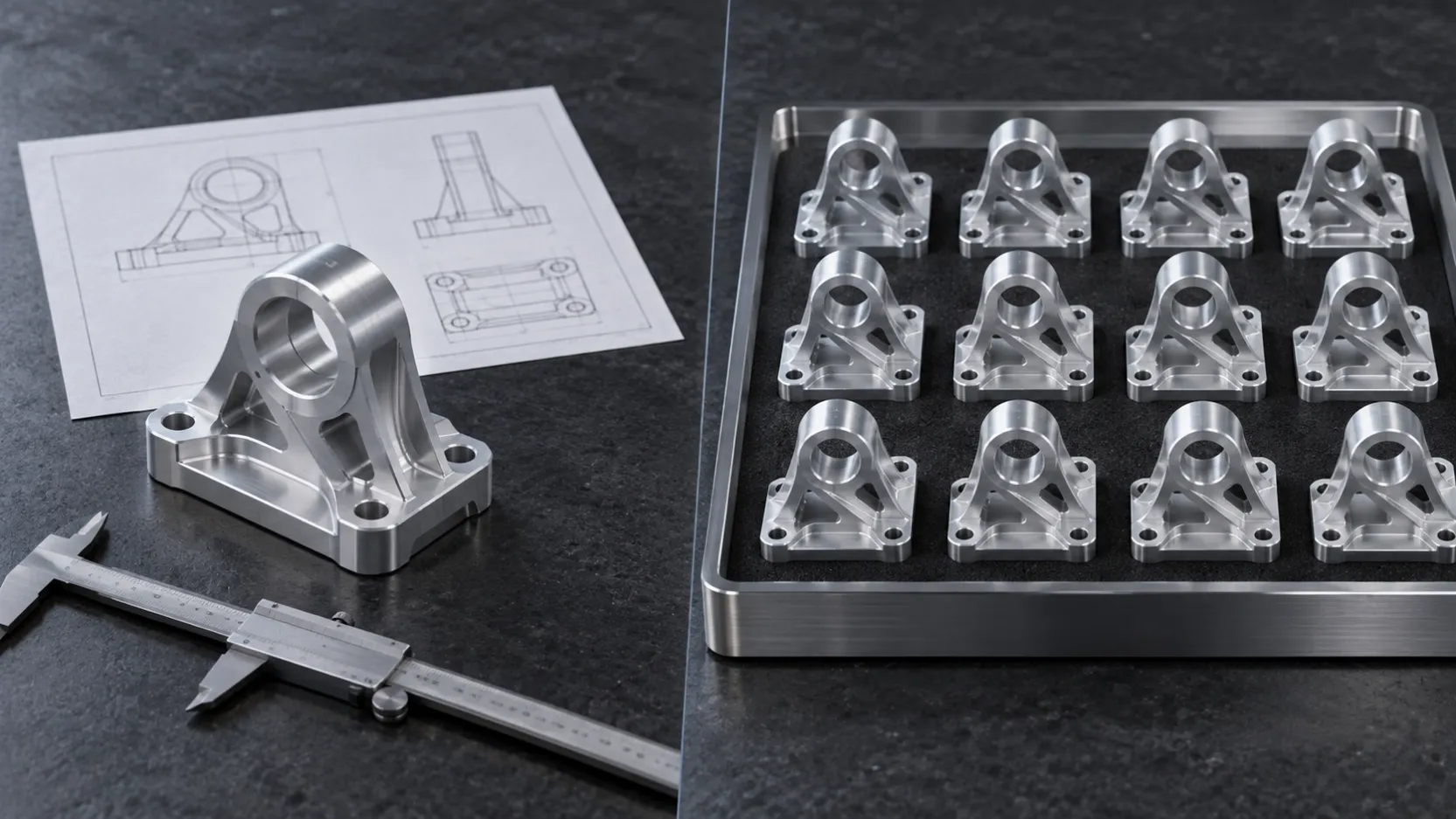
Low-volume CNC machining fills the gap between one-off prototypes and stable mass production. Buyers use it for engineering validation, pilot builds, market testing, replacement parts, custom equipment, urgent supply, and bridge production while tooling or a permanent supply chain is being prepared.
Small quantity does not mean simple manufacturing. A batch of 10, 50, or 200 parts may still require controlled materials, fixtures, tool-life planning, dimensional reports, finishing, packaging, and repeat-order consistency.
What Is Low-Volume CNC Machining?
Low-volume CNC machining usually refers to quantities that are too high for informal prototype methods but too low to justify high-cost mass-production tooling. The exact range depends on part size, geometry, material, cycle time, and annual demand.
The process may include CNC milling, CNC turning, multi-axis machining, grinding, EDM, heat treatment, surface finishing, and assembly. The correct combination depends on the drawing and functional requirements.
When Buyers Use Low-Volume Production
Common situations include:
• Engineering and design validation
• Pilot production before launch
• Bridge production while molds or dies are being built
• Limited-edition industrial equipment
• Replacement and legacy components
• Demand that is uncertain or seasonal
• High-mix, low-volume machinery
• Urgent recovery from supply disruption
The supplier should understand why the batch is needed because prototype, bridge, and repeat-production orders require different planning.
Prototype vs. Low-Volume Production
A prototype often focuses on proving geometry, assembly, and basic function. Low-volume production adds repeatability, traceability, inspection planning, finish consistency, and controlled packaging.
A prototype may use flexible workholding and more manual inspection. A repeat batch may justify dedicated soft jaws, fixtures, in-process probing, standardized tools, inspection gauges, or documented setup instructions.
Buyers should tell the supplier whether the design is frozen, whether revisions are expected, and whether the order may become recurring production.
Design and Manufacturability Review
Before quotation, the supplier should review machining access, internal radii, deep pockets, thin walls, threads, undercuts, datum structure, tolerance stack-up, and inspection feasibility.
A useful review separates critical-to-function features from general dimensions. Tight tolerances applied everywhere can increase setup time, inspection effort, scrap risk, and price without improving performance.
Where permitted, small changes to corner radii, pocket depth, wall thickness, or tolerance can reduce risk and shorten lead time.
Fixture Strategy
Workholding is a key decision in low-volume machining. A one-off part may use standard vises, modular fixtures, or soft jaws. Repeated batches may benefit from dedicated fixtures that reduce setup time and improve consistency.
The quotation should clarify whether fixture costs are included, whether tooling remains with the supplier, and whether future orders can reuse the setup.
For multi-face parts, 4-axis or 5-axis machining may reduce the number of setups and improve relationships between critical features. It is useful when geometry and tolerance justify it, not simply because the machine is available.
Material and Supply Planning
Specify the exact material grade, condition, standard, and certification requirement. Low-volume orders may be affected by minimum material purchase quantities and local availability.
Provide forecast quantities if future orders are possible. A supplier may be able to reserve material, standardize stock size, or reduce future lead time when demand is visible.
If substitutes are allowed, define the approval process. Never assume a supplier may change material without written authorization.
Tolerances and Inspection
Inspection requirements should match risk. Critical fits, sealing surfaces, hole locations, datums, threads, runout, flatness, and profiles may require specific methods.
Confirm:
• First-piece or first-article inspection
• Full inspection of critical dimensions
• Sampling for noncritical features
• CMM or optical inspection where appropriate
• Material and finishing certificates
• Drawing revision on the report
• Lot traceability
• Retention of inspection records
The inspection plan should be agreed before production, not added after parts are complete.
Surface Finishing and Secondary Operations
Anodizing, passivation, plating, heat treatment, grinding, polishing, blasting, coating, laser marking, and assembly may affect final dimensions and lead time.
State the controlling standard, color, thickness, masking, cosmetic surfaces, and dimensions that apply after finishing. Secondary processing can become the longest lead-time item, so include it in the RFQ from the beginning.
Cost Drivers in Low-Volume Machining
Unit price is influenced by programming, setup, material, machining time, tool wear, fixture cost, finishing, inspection, packaging, and quantity. Small batches carry setup cost across fewer parts.
To compare quotations fairly, check whether each quote includes the same scope:
• Material and certificates
• Programming and setup
• Fixtures or soft jaws
• Machining and deburring
• Surface finishing
• Inspection reports
• Packaging
• Shipping terms
• Lead time
The lowest unit price may not be the lowest total cost if inspection, finishing, or rework is excluded.
Reducing Lead Time Without Increasing Risk
Lead time can improve when files are complete, material is available, tolerances are clear, finishing is confirmed, and approvals are fast.
Useful buyer actions include providing PDF and STEP files together, marking critical features, approving technical questions promptly, separating prototype and production requirements, and avoiding late changes after material or fixtures are prepared.
RFQ Checklist
For an accurate low-volume CNC machining quote, provide:
• 2D drawing with revision, tolerances, datums, and notes
• STEP or another neutral 3D model
• Exact material grade and condition
• Quantity for this order
• Expected future batch sizes and annual demand
• Critical dimensions and inspection requirements
• Surface finish and secondary processing
• Certificates and traceability
• Packaging and labeling requirements
• Target delivery date and destination
• Whether the design is frozen or may change
If the drawing and model conflict, identify which file controls.
How to Evaluate a Supplier
Ask whether the supplier can support both the current batch and future revisions. Review similar-part experience, equipment, fixture approach, inspection, revision control, communication, secondary-process management, and handling of nonconforming parts.
A reliable supplier should explain risk and assumptions before accepting the order.
Why Work With Zync Precision
Zync Precision supports prototype, low-volume, and repeat-production CNC milling and turning. We review drawings, materials, tolerances, finishing, inspection, and delivery requirements before quotation. Our capabilities include multi-axis machining, material traceability, dimensional inspection, and quality documentation.
Request a Low-Volume CNC Machining Quote
Send your drawing, 3D model, material, quantity, finish, inspection requirements, and target date. Include future volume expectations so we can recommend an appropriate process and fixture strategy.
Frequently Asked Questions
What quantity is considered low volume?
There is no universal number. It depends on part size, machining time, setup cost, material, and expected repeat demand.
Is CNC machining suitable for bridge production?
Yes. CNC machining can supply production-representative parts while permanent tooling or a long-term production process is being prepared.
Do low-volume parts need dedicated fixtures?
Not always. Standard workholding may be enough for prototypes, while repeat batches or critical tolerances may justify dedicated fixtures.
Can the same process be used for future production?
Sometimes. The supplier may optimize fixtures, tools, cycle time, and inspection as volume increases.
What information reduces quotation time?
Complete drawing and model files, material, quantity, critical tolerances, finish, inspection, packaging, and delivery requirements reduce assumptions and delays.