Sep 1, 2026Case Studies
High-Precision CNC Machining of PVDF Cylinder Plugs
Case study of 12 custom PVDF cylinder plugs produced by Swiss-type CNC turning, featuring tight tolerances, precision sealing surfaces, dimensional inspection, and reliable small-batch prototyping.
Project Overview
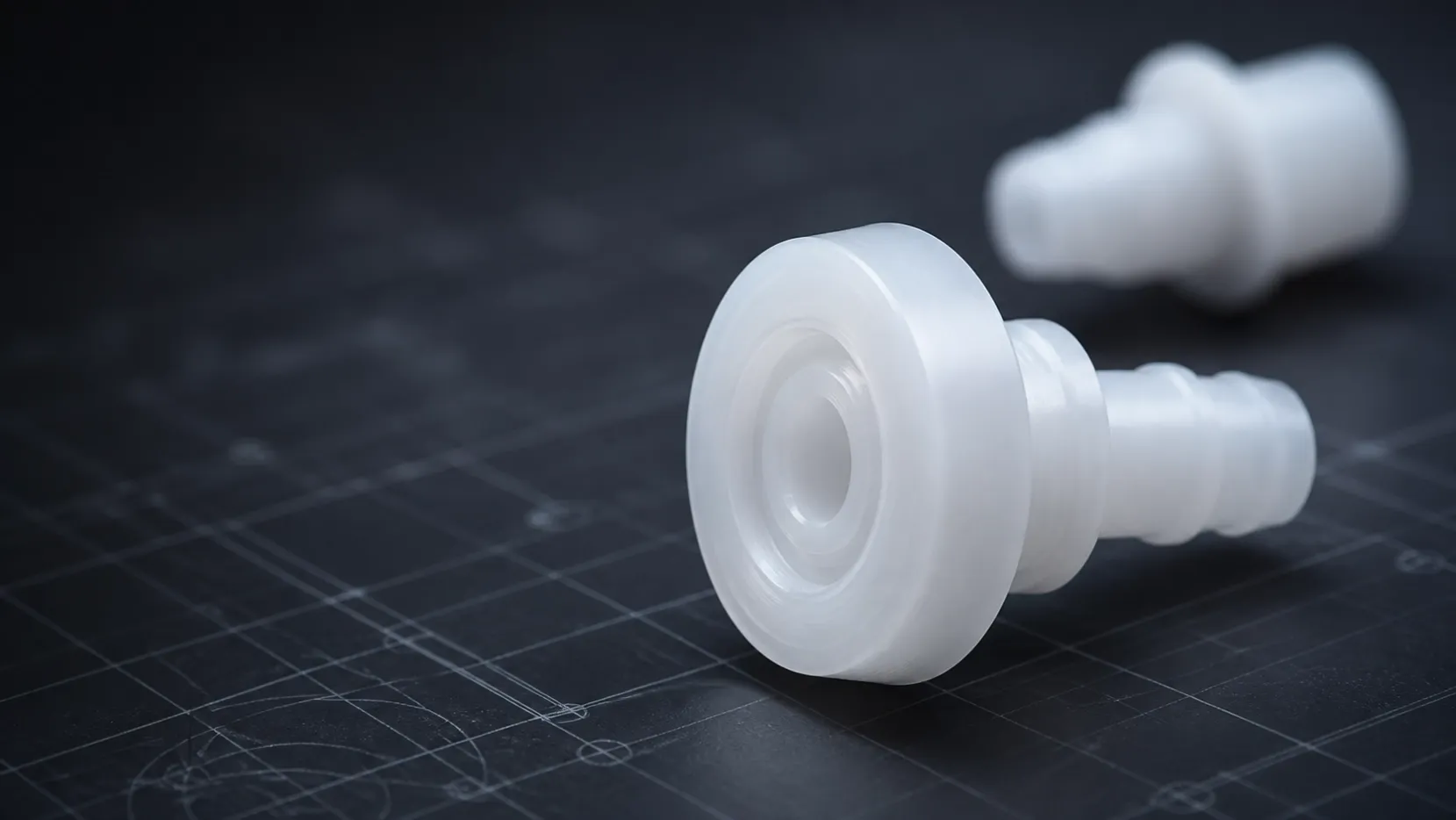
Zync Precision manufactured a small batch of custom PVDF cylinder plugs for a precision sealing and fluid-control application. The project required stable dimensions, clean sealing surfaces, and consistent part quality across a 12-piece prototype batch.
Part Name: PVDF Cylinder Plug / Stopper
Application: Precision sealing and fluid connection for pneumatic or chemical-handling equipment
Quantity: 12 pieces
Manufacturing Process: Swiss-type CNC turning
Material: PVDF (Polyvinylidene Fluoride)
The main challenge was producing miniature polymer components with tight dimensional requirements while controlling deformation caused by material stress, cutting heat, and the flexible nature of PVDF.
Technical Requirements
The component featured a stepped flange, a tapered connection, internal grooves, and several precision sealing surfaces within a compact overall size.
Key project requirements included:
• Tight dimensional control on critical sealing features
• Surface roughness requirement of Ra ≤ 0.8 μm on specified surfaces
• Concentricity between the flange, cylindrical body, and connection features
• Clean edges with controlled burrs
• Consistent dimensions across the complete prototype batch
• Protection of the soft PVDF surface during handling and inspection
Final tolerances and inspection criteria were confirmed according to the customer drawing.
Why PVDF Is Challenging to Machine
PVDF offers excellent chemical resistance, low moisture absorption, and good mechanical performance. These properties make it suitable for chemical-processing, fluid-control, semiconductor, and industrial equipment applications.
However, precision machining of PVDF requires careful process control. Excessive cutting pressure or heat may cause deformation, dimensional movement, poor surface finish, or unstable tolerances.
Our engineering team reviewed the part geometry, material behavior, tooling, workholding, cutting parameters, and inspection requirements before production.
Swiss-Type CNC Turning Strategy
Swiss-type CNC turning was selected because the component was small and required stable support close to the cutting area.
The sliding headstock and guide-bushing configuration helped reduce part deflection during machining. The process also allowed multiple external and internal features to be completed with fewer setups.
The manufacturing strategy included:
• Sharp cutting tools suitable for engineering plastics
• Controlled cutting speed and feed rate
• Low cutting pressure to reduce deformation
• Careful heat management during machining
• Stable support close to the cutting area
• Process sequencing designed to protect critical sealing surfaces
• Controlled deburring without damaging the PVDF component
Inspection and Quality Control
Quality control was integrated throughout the project rather than performed only after production.
Inspection activities included:
• Incoming material verification
• First-article dimensional inspection
• In-process checks of critical dimensions
• Verification of sealing diameters and flange features
• Visual inspection for burrs, scratches, and surface damage
• Final dimensional inspection before shipment
• Inspection documentation according to project requirements
Zync Precision operates ISO 9001 and IATF 16949 certified quality management systems. Customer-specific inspection requirements and documentation can be reviewed during quotation.
Project Results
The 12-piece prototype batch was completed using the approved Swiss-type CNC turning process.
The finished components provided:
• Consistent critical dimensions across the batch
• Clean sealing surfaces
• Controlled burrs and protected edges
• Stable concentricity between machined features
• Reliable repeatability for future production planning
The project demonstrated how appropriate tooling, process control, and dimensional inspection can improve the reliability of small-batch PVDF machining.
Applications for Machined PVDF Components
Custom CNC-machined PVDF components are commonly used in:
• Chemical-processing equipment
• Fluid-control systems
• Semiconductor manufacturing equipment
• Pneumatic equipment
• Laboratory and analytical instruments
• Medical and industrial equipment
• Electrical insulation applications
• Corrosion-resistant assemblies
Request a PVDF Machining Quote
Zync Precision supports custom PVDF CNC machining for prototypes, low-volume orders, and repeat production.
To receive a manufacturing review and quotation, please provide:
• 2D drawings or 3D CAD files
• Material grade
• Required quantity
• Critical dimensions and tolerances
• Surface-finish requirements
• Inspection and documentation requirements
• Expected delivery date
Our engineering team will review manufacturability, tolerances, inspection requirements, and production options before quotation.
Frequently Asked Questions
What information is required for a PVDF machining quotation?
Please provide your 2D drawing or 3D CAD file, PVDF grade, quantity, tolerances, surface-finish requirements, inspection requirements, and expected delivery date.
Can you machine PVDF prototypes and small batches?
Yes. We support prototype development, small-batch machining, and repeat production according to customer drawings and technical requirements.
Why is PVDF difficult to machine accurately?
PVDF may deform under excessive cutting pressure or heat. Stable workholding, sharp tooling, controlled cutting parameters, and appropriate inspection methods are important for maintaining dimensional accuracy.
Can you provide inspection reports?
Yes. Dimensional inspection reports, first-article inspection, CMM inspection, and other quality documentation can be provided according to project requirements and feasibility.
Do you manufacture other engineering-plastic components?
Yes. We evaluate custom components made from PVDF and selected engineering plastics according to the drawing, material grade, tolerances, geometry, and application requirements.
Are customer drawings kept confidential?
Yes. Customer drawings and project information are handled confidentially. NDA arrangements are available upon request.