Sep 18, 2026CNC Machining Guides
CNC Milling vs. CNC Turning: How to Choose the Right Process
Compare CNC milling and CNC turning, including part geometry, materials, tolerances, production volume, and cost factors, to choose the right process for your custom part.
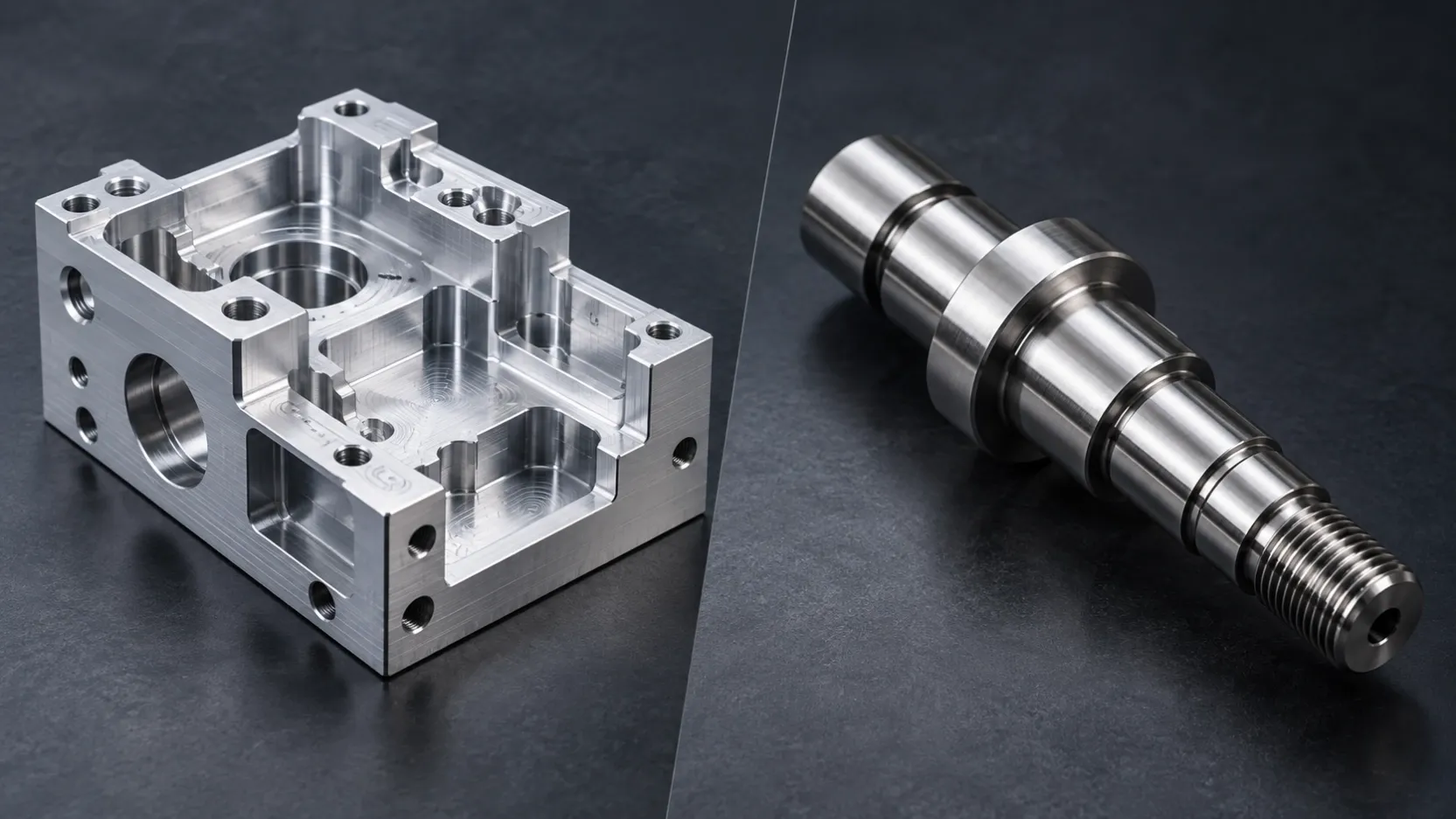
CNC milling and CNC turning are two of the most widely used processes for manufacturing custom precision metal parts. Both can produce accurate components from customer drawings, but they remove material in different ways and are suited to different part geometries.
Choosing the right process can simplify production, reduce unnecessary machining, and make quotation more accurate. The decision should be based on the complete drawing, material, quantity, tolerances, surface finish, and inspection requirements—not only the general appearance of the part.
What Is CNC Milling?
CNC milling uses rotating cutting tools to remove material from a workpiece. The workpiece is held in place while the cutting tool moves along programmed axes to create the required geometry.
Milling is commonly considered for parts that contain:
- Flat faces and pockets
- Slots and channels
- Drilled or tapped holes
- Multiple mounting surfaces
- Irregular external profiles
- Features located on several sides
- Complex three-dimensional contours
Typical drawing-based milling enquiries include housings, brackets, plates, fixtures, manifolds, structural components, and machine parts.
What Is CNC Turning?
CNC turning rotates the workpiece while a cutting tool removes material from its outside or inside diameter. This process is primarily suited to parts whose main geometry is arranged around a central axis.
Turning is commonly considered for parts that contain:
- Outside and inside diameters
- Steps and shoulders
- Bores and counterbores
- Grooves
- Tapers
- External or internal threads
- Concentric cylindrical features
Typical drawing-based turning enquiries include shafts, pins, bushings, sleeves, spacers, rollers, and threaded components.
CNC Milling vs. CNC Turning: The Main Difference
The simplest distinction is how the material and cutting tool move.
In CNC milling, the cutting tool rotates and moves across a workpiece that is normally held stationary. In CNC turning, the workpiece rotates while the cutting tool follows the programmed profile.
This difference influences which process can create the required geometry efficiently.
A rectangular housing with pockets and holes is generally a milling application. A stepped shaft with concentric diameters and threads is generally a turning application. Some components combine cylindrical and non-cylindrical features and may require more than one machining operation.
Compare the Part Geometry First
Part geometry is usually the most important factor when selecting a machining process.
Choose CNC milling for review when the design is primarily prismatic, rectangular, plate-like, or contains features on multiple faces.
Choose CNC turning for review when the design is primarily round and most critical features are concentric with the part’s central axis.
A mostly cylindrical part may still require milling when it includes flats, cross holes, keyways, slots, or off-center features. Likewise, a milled component may require turned inserts or other separately manufactured cylindrical parts.
Send the complete drawing rather than selecting a process based only on the part name.
How Material Influences the Decision
Many engineering metals can be machined by either milling or turning, but material behavior affects cutting conditions, tool selection, surface finish, and cost.
Common materials submitted for review may include:
- Aluminum alloys
- Stainless steels
- Carbon and alloy steels
- Brass and copper alloys
- Engineering plastics
- Other materials specified by the customer
The material grade and condition should be stated clearly on the drawing or RFQ. For example, heat treatment, hardness, temper, or supplied material condition may affect the manufacturing plan.
Material certification requirements should also be identified before quotation.
Tolerances and Datum Requirements
Both CNC milling and CNC turning can support precision manufacturing, but achievable tolerances depend on more than the machine type.
Important factors include:
- Part size and geometry
- Material and heat-treatment condition
- Feature accessibility
- Wall thickness
- Required surface finish
- Datum structure
- Relationship between features
- Inspection method
- Production quantity
Turning is often appropriate for controlling relationships between cylindrical features, such as concentric diameters and shoulders. Milling is often appropriate for controlling positions between faces, holes, pockets, and mounting features.
Only apply tight tolerances where they are functionally required. Unnecessarily tight tolerances can increase machining time, inspection requirements, scrap risk, and cost.
If a tolerance is critical to assembly or performance, identify it clearly on the drawing.
Surface Finish Considerations
The required surface finish should be defined for the functional surfaces that need it.
Machined surface appearance can vary according to:
- Material
- Cutting direction
- Tool condition
- Feed and speed
- Feature geometry
- Required roughness
- Secondary finishing
If a specific roughness value is required, include it on the drawing. Do not rely only on general terms such as “smooth finish.”
Secondary operations such as anodizing, plating, passivation, coating, polishing, or heat treatment should be identified during quotation because they may affect dimensional allowances and inspection planning.
Production Quantity and Cost
Neither milling nor turning is automatically the lower-cost process in every situation.
Cost depends on:
- Raw material size and form
- Number of setups
- Machining time
- Tool access
- Number of operations
- Tolerance requirements
- Inspection scope
- Secondary processing
- Order quantity
A round component produced from bar stock may be efficient to turn. A rectangular component may be better suited to milling from plate or block material.
For repeat orders, stable drawings, realistic tolerances, and consistent material specifications can help improve production planning.
When a Part Requires Both Milling and Turning
Some designs contain both rotational and non-rotational features.
Examples include:
- A shaft with milled flats
- A bushing with radial holes
- A turned sleeve with a keyway
- A cylindrical component with mounting slots
- A threaded part with an off-center feature
These components may require a combination of turning and milling operations. The most appropriate sequence depends on the datum structure, critical features, quantity, and inspection requirements.
Do not divide the RFQ into separate processes unless your drawing already requires separate components. Submit the complete part drawing so the full manufacturing route can be reviewed.
What to Include in Your RFQ
For a useful manufacturing review and quotation, provide as much of the following information as possible:
- 2D drawing in PDF format
- 3D model in STEP or another suitable format
- Material grade and condition
- Required quantity
- Prototype or repeat-production requirement
- Critical tolerances
- Surface-finish requirements
- Heat treatment or coating
- Inspection and documentation requirements
- Target delivery date
- Application information when relevant
Customer drawings and project information should be reviewed only for manufacturing and quotation purposes.
Which Process Should You Choose?
Use CNC milling as the starting point when the part is mainly prismatic and includes faces, pockets, slots, or holes on different surfaces.
Use CNC turning as the starting point when the part is mainly cylindrical and includes diameters, bores, shoulders, grooves, or threads around a central axis.
If the design includes both types of features, send the full drawing for process review. The manufacturing method should follow the functional requirements of the part rather than a general product label.
Request a Manufacturing Review
Zync Precision reviews custom CNC machining enquiries based on customer drawings and project requirements.
Send us your drawing or 3D model together with the material, quantity, tolerances, finishing, and inspection requirements. We will review the part for an appropriate manufacturing approach and quotation.