Sep 24, 2026CNC Machining Guides
CNC Milling Parts Manufacturer: Buyer’s Guide to Capability, Quality & RFQ
How to evaluate a CNC milling parts manufacturer by machine capability, tolerances, materials, inspection, production control, communication, and RFQ quality.
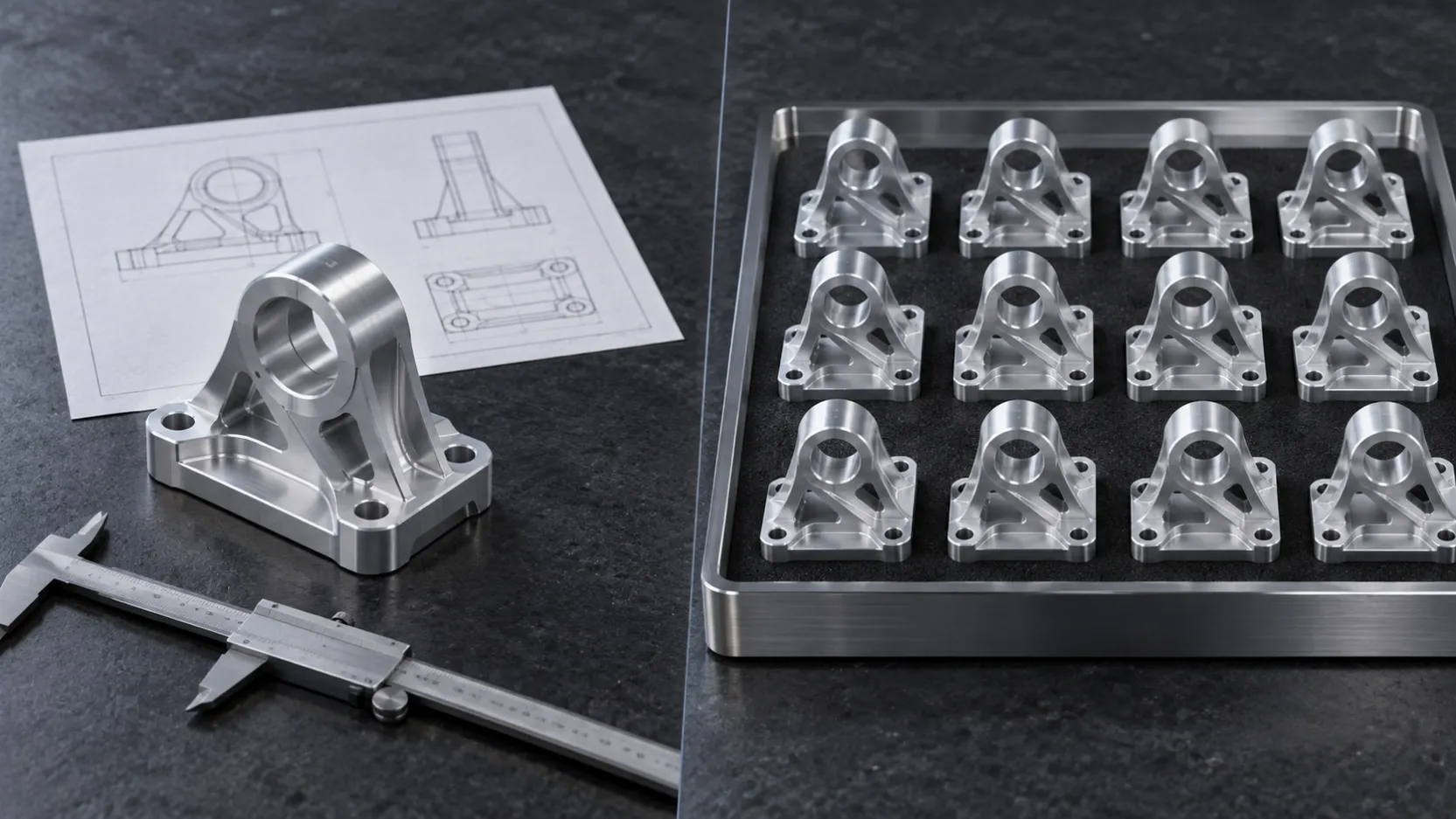
Choosing a CNC milling parts manufacturer is not only a price comparison. The supplier must understand your drawing, identify manufacturing risks, control critical features, and deliver repeatable parts with the required documentation. A low unit price is not useful if parts arrive late, dimensions drift between batches, or inspection records do not match the drawing revision.
This guide explains what buyers and engineers should evaluate before sending an RFQ or approving a new CNC milling supplier.
What Does a CNC Milling Parts Manufacturer Do?
A CNC milling manufacturer produces custom parts by removing material with rotating cutting tools. Milling is commonly used for housings, brackets, plates, manifolds, fixtures, covers, frames, and components with pockets, holes, slots, threads, or multiple machined faces.
The process may include 3-axis milling, 4-axis machining, or 5-axis machining. The best method depends on geometry, tolerances, quantity, material, inspection requirements, and total manufacturing cost. Complex parts do not always require five-axis machining, but multi-axis capability can reduce setups and improve relationships between features on different faces.
- Match the Supplier’s Capability to Your Part
Start with the geometry rather than the machine list. Ask whether the supplier has produced parts with similar features, materials, tolerances, and inspection requirements.
Important questions include:
• Can the part be completed in one setup or will it require several operations?
• How will thin walls, deep pockets, small holes, or long-reach features be controlled?
• Are critical datums accessible during machining and inspection?
• Does the supplier have suitable workholding for prototypes and repeat production?
• Can secondary operations be managed without losing dimensional control?
A capable supplier should explain the proposed process and point out risks before production begins.
- Review Tolerances Feature by Feature
Applying the tightest tolerance to every dimension increases cost and can create unnecessary manufacturing difficulty. Identify which dimensions control assembly, sealing, alignment, motion, or safety.
The RFQ should clearly show:
• Critical dimensions and their tolerances
• Datum references and geometric controls
• Hole position and thread requirements
• Flatness, perpendicularity, parallelism, or profile requirements
• Surface finish on functional areas
• Inspection method or reporting expectations
If a tolerance is essential, explain the function when possible. This helps the manufacturer choose a stable process and inspection method.
- Confirm Material and Certification Requirements
Specify the exact material grade, temper, condition, and applicable standard. “Aluminum” or “stainless steel” is usually not enough for a production RFQ.
Common CNC milling materials include aluminum alloys, stainless steels, carbon and alloy steels, brass, copper, titanium, and engineering plastics. Each material behaves differently during cutting. Tool wear, heat, distortion, burr formation, surface finish, and achievable cycle time can all change.
State whether you need material certificates, heat or lot traceability, approved substitutes, customer-supplied material, or special handling. Material availability can affect both lead time and price, so confirm it early.
- Evaluate Inspection and Quality Control
A professional CNC milling parts manufacturer should connect the inspection plan to the drawing. The goal is not to measure everything in the same way; it is to use the right method for each requirement.
Depending on the part, inspection may use calipers, micrometers, height gauges, thread gauges, surface roughness testers, optical equipment, or a coordinate measuring machine. Complex profiles and positional relationships may need CMM inspection, while threaded and functional features may require gauges.
Before placing the order, agree on first-piece inspection, sampling plans, full inspection of critical characteristics, report format, drawing revision control, material certificates, nonconformance handling, and record retention.
- Consider Prototype and Production Needs Separately
Prototype machining focuses on learning quickly: confirming geometry, assembly, material behavior, and design changes. Production machining focuses on repeatability, cycle time, workholding, tool life, inspection efficiency, and stable supply.
Tell the supplier whether the RFQ is for a one-off prototype, engineering validation units, a pilot batch, bridge production, or recurring production. Also provide expected annual volume and likely batch size. This helps the supplier decide whether simple prototype fixtures are enough or dedicated workholding is justified.
- Check Surface Finish and Secondary Processes
Secondary processes can affect final dimensions, appearance, corrosion resistance, conductivity, hardness, and assembly. Examples include anodizing, passivation, plating, heat treatment, polishing, blasting, coating, laser marking, and grinding.
Define the required standard, color, thickness, masking areas, cosmetic surfaces, and dimensions that apply after finishing. Threaded holes, bearing fits, sealing surfaces, and electrical contact areas may need special protection or machining allowance.
- Assess Communication Before You Place the Order
The quotation process reveals how the supplier will communicate during production. Clear technical questions are usually a positive sign. Silence may mean important assumptions are being made without your approval.
Look for a supplier that confirms the drawing revision and files received, separates relevant costs, states lead time and quotation validity, identifies missing information, explains manufacturing concerns, records approved changes, and provides clear technical and commercial contacts.
- Compare Total Cost, Not Only Unit Price
Two quotations may describe different scopes. One supplier may include material certification, finishing, full inspection, and export packaging, while another quotes machining only.
Compare material grade and source, quantity assumptions, tooling charges, inspection, surface treatment, packaging, shipping terms, lead time, payment terms, and responsibility for nonconforming parts.
RFQ Checklist for CNC Milled Parts
For a faster and more accurate quotation, send:
• A 2D PDF drawing with dimensions, tolerances, datums, notes, and revision
• A STEP model or another neutral 3D CAD format
• Exact material grade and condition
• Order quantity and forecast quantity
• Critical tolerances and functional features
• Surface finish and secondary processing
• Inspection and certificate requirements
• Cosmetic and packaging requirements
• Target delivery date and destination
• Confidentiality or regulatory requirements
If the drawing and model conflict, state which file controls. Highlighting critical-to-quality features can reduce clarification time.
Common Warning Signs
Be cautious when a supplier quotes without reviewing the drawing, ignores critical tolerances, cannot explain inspection, changes material without approval, does not control revisions, promises unrealistic lead time without discussing material and tooling, or cannot define how repeat orders will remain consistent.
Why Buyers Work With Zync Precision
Zync Precision supports custom CNC milling and turning for prototypes and production parts. Our team reviews customer drawings, materials, tolerances, finishing, inspection, and delivery requirements before quotation. We support complex geometries, multi-axis machining, material traceability, dimensional inspection, and quality documentation for industrial components.
Request a CNC Milling Quote
Send your drawing, 3D model, material, quantity, tolerance, finish, inspection requirements, and target delivery date. We will review the manufacturing approach and identify points that need clarification before quoting.
Frequently Asked Questions
What files are best for a CNC milling RFQ?
A dimensioned PDF drawing and a STEP model are the most useful combination. The drawing communicates tolerances, datums, finish, and notes, while the 3D model defines geometry.
Can one supplier handle both prototypes and production?
Yes, but confirm how the process changes as volume increases. Prototype workholding may not be suitable for repeat production, and the inspection plan may also need to change.
When is five-axis machining useful?
Five-axis machining is useful for complex multi-face parts, angled features, and geometries that benefit from fewer setups. It is not automatically the best choice for every part.
Should every dimension receive a tight tolerance?
No. Tight tolerances should be applied to dimensions that affect function, fit, sealing, alignment, or safety. Unnecessary tight tolerances can increase cost and lead time.
What should an inspection report include?
It should identify the part number, drawing revision, measured characteristic, specification, result, inspection equipment or method when required, and inspected quantity or sample plan.
How can I receive a more accurate quotation?
Provide complete files, exact material, quantity, critical tolerances, finish, inspection requirements, packaging, and delivery expectations. Clear information reduces assumptions and quote revisions.