CNC Machining Guides
CNC Machining vs Sheet Metal: Which Process Fits Your Part?
A buyer's guide to choosing CNC machining or sheet metal fabrication: cost, tolerances, design rules, lead time, and when a machined part or a sheet metal assembly is the better fit.
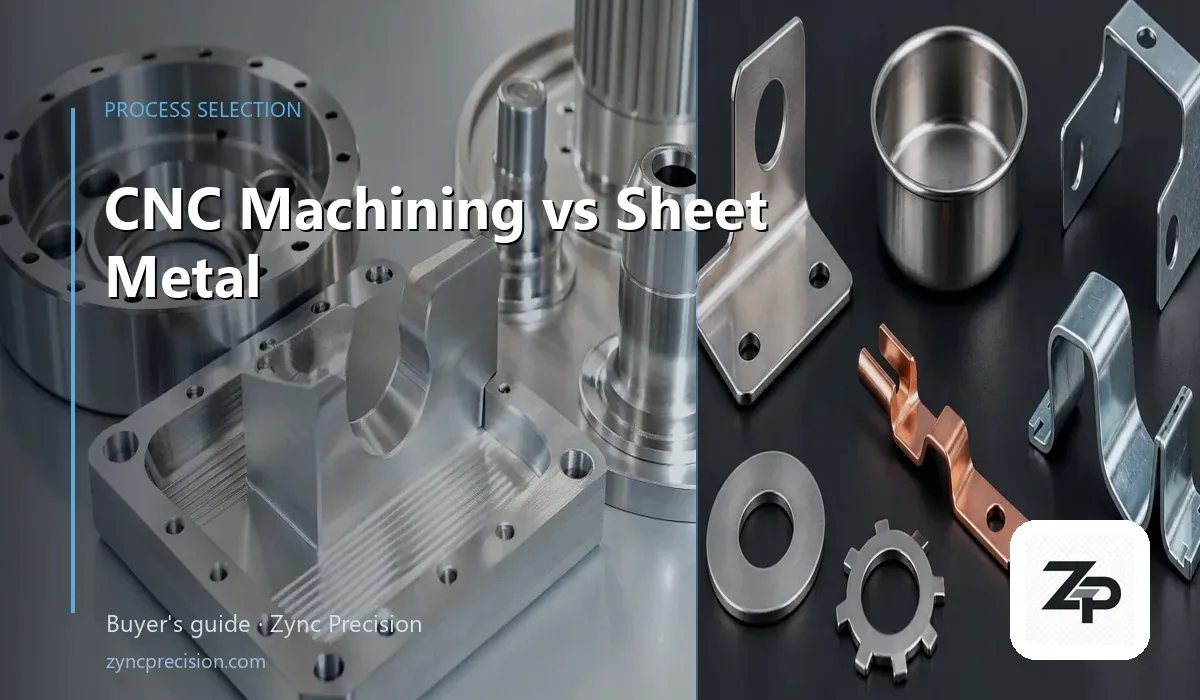
A bracket or enclosure can be laser-cut and bent for a fraction of the cost of machining from solid. Then the bearing bore, thread, flatness, or cosmetic face arrives, and the cheap sheet metal part needs a machining operation, an insert, or a redesign.
Sheet metal fabrication and CNC machining are not interchangeable. One forms thin material into a structure; the other cuts a solid block into a precise part. The right choice depends on the geometry, the tolerance, the volume, and how the part will be assembled.
This guide is written for buyers and engineers who need to compare the two processes without comparing a bare bracket price to a finished precision part.
The Short Answer
Use sheet metal when the part is thin-walled, the shape is mostly 2D or formed from flat material, the volume is low-to-medium, the finish is cosmetic or protective, and the tolerances can be met by cutting, bending, and welding.
Use CNC machining when the part is solid or thick, the geometry is 3D, the tolerances are tight, the part needs threads, bearing fits, sealing faces, or flatness, or the volume is low and the design may change.
Many products use both: a sheet metal enclosure, a machined mounting plate, a welded frame with machined pads, or a bracket with a machined insert. The interface is where the cost and the risk usually sit.
What Sheet Metal Fabrication Does Well
Sheet metal fabrication combines laser cutting or punching, bending, welding, hardware insertion, and finishing. Tooling is usually low: programming, a few fixtures, and standard punch tools. The first part can be made quickly, and the process is efficient for large flat parts.
It is a strong fit for enclosures, panels, covers, brackets, frames, ducts, and chassis. It can produce large parts with good material utilization, and it can integrate bends, louvers, holes, and weld nuts without machining every feature.
The limitations are equally important. Sheet metal is thin, so it can deflect, dent, and distort during welding. Bend radius, bend relief, hole-to-bend distance, and weld access all constrain the design. Tight tolerances and 3D features are difficult without a secondary machining operation.
Sheet metal is also sensitive to handling and finish. A large panel can twist after welding, a thin flange can deform under a clamp, and a powder-coated surface can hide a dent until the customer opens the box. The fixture and the process plan matter as much as the laser.
What CNC Machining Does Well
CNC machining starts from solid stock and cuts the final geometry. It has no forming tool, so it can hold tight tolerances, produce complex 3D contours, cut threads, and hold bearing fits and sealing faces. It is the natural choice for shafts, bushings, manifolds, housings, mold inserts, and precision plates.
The trade-off is unit cost and material waste. Every part carries programming, setup, and cycle time, and a part that removes most of a block can be expensive. Large parts may exceed the machine envelope, and thin walls can vibrate.
Machining is also the process that fixes the interfaces on a sheet metal assembly. A welded frame may be machined after welding to establish flatness, hole position, and bearing bores.
Machining is not always the right answer either. A large enclosure machined from a solid block can be heavy, expensive, and wasteful. If the part is mostly empty space, sheet metal or a weldment is usually the better shape.
The Cost Comparison Buyers Should Do
Sheet metal cost is driven by material, programming, laser or punch time, bending, welding, hardware, finishing, and assembly. CNC cost is driven by material, programming, setup, cycle time, inspection, and finishing.
Compare the total cost of the finished assembly, not the cost of the bracket. Add the machining of critical features, the inserts, the fasteners, the welding, the straightening, the finish, and the inspection.
At low volume, sheet metal usually has lower tooling and a faster path to the first part. At high volume, laser and punch efficiency improve, but welding and assembly remain labor-intensive. CNC has no tooling, but its unit time is higher; at low volume, that can still be the lower total cost.
Ask the fabricator for the material utilization, the number of bends and welds, the hardware, the finish, the flatness after welding, and the assembly tolerance. Ask the machinist for the setup count, the material, the tolerance, the inspection, and the repeat price.
Do not forget the cost of assembly. A sheet metal design with 40 fasteners, 12 welds, and a machined insert may be more expensive than a single machined part at low volume. Count the operations, not just the material.
Tolerances and Quality
Sheet metal tolerances are affected by cutting, bending, springback, welding, and handling. Bend angle, flatness, hole position, and weld distortion are often more important than a single dimensional tolerance. Critical features are usually machined after welding or added as inserts.
CNC machining can hold tight dimensional tolerances, flatness, parallelism, and surface finish, and it can produce threads and bearing fits. The inspection plan usually includes a first article, in-process checks, and CMM reports for critical features.
If a sheet metal part needs a precision bore, do not ask the brake press to hold it. Weld the structure, stress-relieve it if needed, then machine the bore in the same setup as the mounting datum. That is a hybrid process, and it should be planned from the beginning.
The same logic applies to flatness and hole position. A welded frame may need stress relief before machining; a thin panel may need a fixture to hold it flat. If the drawing does not say how the part will be held, the quote will include an assumption.
Design Rules for Sheet Metal
Use a bend radius that matches the material and thickness, add bend relief, keep holes away from the bend line, and leave enough flange for the tooling. Design weld access so the welder can reach both sides, and avoid overlapping welds that distort the part.
Specify hardware and inserts early. A weld nut, clinch nut, or rivet nut needs clearance and a flat surface. If the part will be powder-coated, mask the threads and the grounding points.
Design Rules for CNC Machining
Design for tool access, internal corner radius, pocket depth, thin walls, and workholding. Reduce the number of setups by putting features on accessible faces and using a consistent datum. If the part is thin and large, it may need a fixture or support to avoid chatter.
A sheet metal design with uniform thin walls may be flexible and expensive to machine. A machined design with thick sections may be heavy and expensive to form. The geometry should follow the process, not the other way around.
When a Hybrid Makes Sense
A common hybrid is a sheet metal enclosure with a machined mounting plate or a machined insert. Another is a welded frame that is machined after welding to establish flatness, hole position, and bearing bores.
Design the interface first: which surface is the datum, which holes are the reference, how the parts are assembled, and who owns the tolerance stack-up. A hybrid part is only as good as its interface.
A Decision Checklist
Start with the geometry. Is the part mostly flat and thin, or is it a solid 3D shape?
Check the thickness. Thin walls favor sheet metal; thick sections favor machining.
List the critical features. Threads, bearing fits, sealing faces, and flatness usually need machining.
Estimate the volume. Low volume favors machining; high volume can favor sheet metal tooling and assembly.
Define the finish. Powder coat, anodizing, passivation, and paint have different masking and preparation needs.
Count the parts and fasteners. A single machined part may replace a welded assembly, or a sheet metal assembly may replace a large machined block.
Check the lead time and the bridge plan. Sheet metal is fast for the first article; machining is fast for design changes.
Compare the total cost, including assembly, welding, machining, finishing, and inspection.
Common Mistakes Buyers Make
Specifying a tight tolerance on a bend that will be welded afterward.
Forgetting that powder coating adds thickness and can bridge small holes.
Designing a flange that is too narrow for the press brake.
Assuming a sheet metal bracket can hold a bearing bore without a machined insert.
Comparing a bare bracket price with a finished machined assembly.
A Simple Example: The Bearing Bracket
A bracket looks like a sheet metal part: flat base, two bends, four mounting holes. But the drawing also has a bearing bore with a tight fit and a flat mounting face. The low-cost route is a laser-cut and bent bracket with a machined insert or a post-weld machining operation. The one-piece machined bracket may have a higher piece price but fewer operations and a more predictable bore.
The right choice depends on volume, the load, the assembly, and the tolerance. The mistake is quoting the sheet metal bracket without the bore, then discovering the extra operation after the customer approves the sample.
How to Get a Useful Quote
Send the STEP model, the 2D drawing, the material and thickness, the quantity, the surface finish, the tolerances, the assembly requirements, and the target date. Tell us which parts are sheet metal and which are machined.
If the part is a sheet metal assembly, mark the interfaces that must be machined. If it is a solid part, tell us whether a sheet metal version is also being considered; that changes the process recommendation.
FAQ
Is sheet metal always cheaper than CNC machining?
For thin-walled brackets and enclosures at low volume, it often is. For thick parts, tight tolerances, complex 3D features, or parts that need threads and bearing fits, machining can be cheaper in total because it avoids assembly and secondary operations.
Can you machine a part that was designed for sheet metal?
Often, but thin walls and formed features may need redesign, and machining from solid may be expensive. Ask for a DFM review before assuming the sheet metal design is machine-ready.
Can sheet metal hold tight tolerances?
It can hold reasonable tolerances, but bending and welding introduce variation. Critical features are usually machined after forming or added as inserts.
A Practical Next Step
Send your drawing, material, quantity, and target date to emily@zyncprecision.com. If the part is a sheet metal assembly, tell us which interfaces must be machined; if it is a solid part, we will quote the machining. We reply with a practical quote within 24 hours.