CNC Machining Guides
CNC Machining vs Casting: Which Process Fits Your Part?
A buyer's guide to choosing CNC machining or casting: tooling, volume, tolerances, porosity, lead time, design rules, and when a cast-then-machined part makes sense.
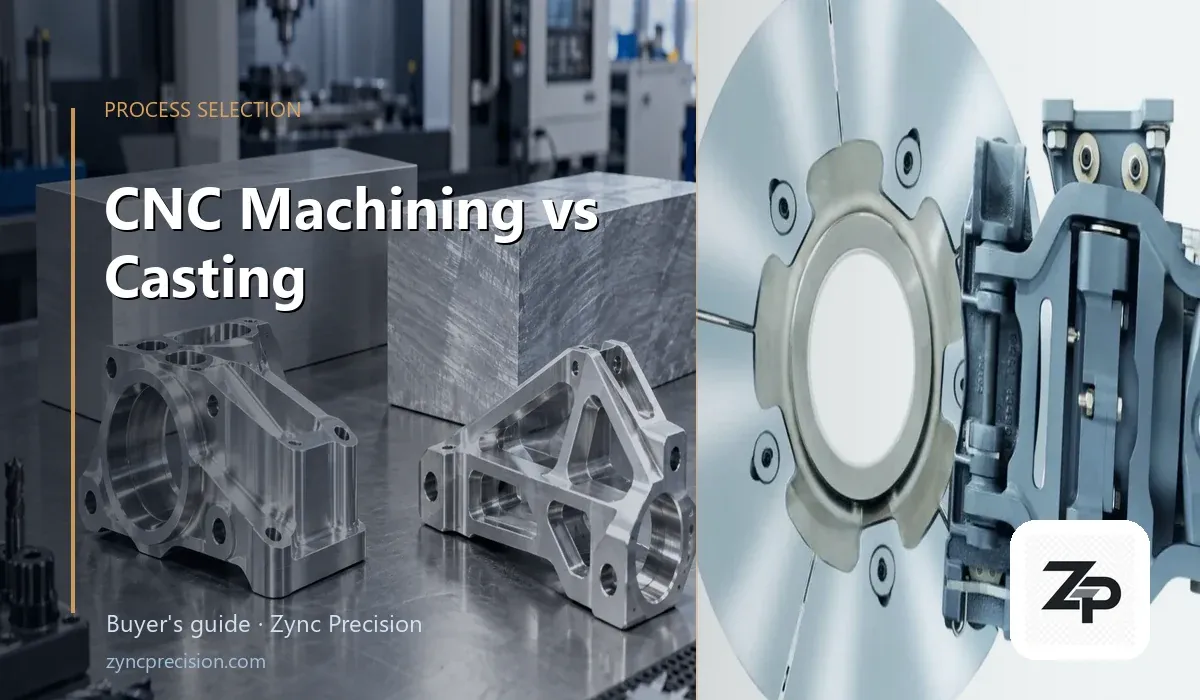
A foundry quote for 500 parts can look much lower than a machining quote. Then the pattern or die cost arrives, the machining allowance is added, the first samples show porosity, and the delivery date moves. The lower piece price was real, but it was not the whole cost.
Casting and CNC machining solve different problems. Casting creates a near-net shape by filling a mold. Machining removes material to create a precise shape. Many precision parts use both: a casting for the bulk shape, machining for the critical surfaces.
This guide is for buyers and engineers who need to compare the two processes on total cost, risk, and fit, not just the first quote.
The most expensive mistake is comparing a casting price with a machining price at different scopes. A casting quote may exclude machining, inspection, and yield; a machining quote may include everything. Put both offers on the same scope before comparing.
The Short Answer
Choose casting when the annual volume is high enough to amortize the tool, the design is stable, the shape is complex or hollow, the material is castable, and the critical features can be machined afterward. Casting is often the economical way to make a near-net shape.
Choose CNC machining when the volume is low or uncertain, the design is still changing, you need parts quickly, the part is made from solid stock, the tolerances are tight, or the geometry is difficult to cast without porosity or distortion.
For many precision parts, the answer is a hybrid: cast the blank, then machine the datums, bores, threads, sealing faces, and other critical features. The decision is not casting or machining; it is how much of each.
What Casting Does Well
Sand casting is flexible and economical for large parts and low-to-medium volumes. Tooling is relatively inexpensive, but tolerances are wider, surface finish is rougher, and machining allowance is needed. It is common for housings, bases, brackets, and large industrial parts.
Investment casting produces finer detail and a better surface than sand casting, with higher tooling cost. It is used for small, complex parts, including stainless steel, aluminum, and superalloys.
Die casting is fast and repeatable at high volume, with thin walls and good surface finish. Tooling is expensive, and porosity, flash, and draft are part of the design. It is common for aluminum and zinc parts.
Permanent mold and low-pressure casting sit between sand and die casting. Each process has its own tooling, minimum volume, tolerance, and defect profile.
The common advantage is shape: casting can create internal passages, hollow sections, and complex exteriors that would be expensive or impossible to machine from solid.
Casting is not automatically cheaper. The tooling, minimum order, machining allowance, and defect risk can erase the piece-price advantage at low volume. The process is strongest when the shape is difficult to machine and the volume is high enough to spread the tool cost.
What CNC Machining Does Well
CNC machining starts from solid bar, plate, or block. It has no pattern or die, so the first part can be made quickly and the design can change between batches. It can hold tight tolerances, produce threads and bearing fits, and machine almost any metal or engineering plastic.
The trade-off is unit cost at volume. Every part carries material, programming, setup, and cycle time. Large amounts of material may be removed, and complex parts may need multiple setups.
Machining is also the finishing process for castings and forgings. It establishes the datums, cuts the critical features, and brings the part into tolerance.
The Cost Comparison Buyers Should Do
A casting quote should include the pattern or die, the piece price, the machining allowance, the expected yield, the inspection, and the logistics. A machining quote should include the material, programming, setup, cycle time, inspection, finishing, and packaging.
Do not compare a casting piece price with a machined piece price. Compare the delivered, inspected, ready-to-use part at the volume you will actually buy.
For a cast-then-machined part, add the casting cost, the machining cost, the inspection of both stages, and the cost of scrap or rework when porosity is exposed during machining.
A simple break-even is the tooling cost divided by the saving per part. If the tool costs 15,000 and the cast-plus-machined route saves 3 per part, the tool pays back at 5,000 parts, before you add yield, inventory, and change risk.
Ask the foundry for the tool life, minimum order, expected yield, porosity acceptance criteria, machining allowance, heat treatment, and material certification. Ask the machinist for the setup count, tolerance, inspection plan, and repeat price.
Also ask how the foundry will handle a casting that is out of tolerance but still machinable. A small dimensional deviation may clean up; a large one may scrap the part. The acceptance criteria should be agreed before the first production lot.
Tolerances and Critical Features
Casting tolerances are wider than machining tolerances. Draft, shrinkage, mold wear, and distortion all affect the as-cast dimensions. Critical features are usually machined after casting.
If a drawing specifies a tight tolerance on an as-cast surface, the quote will be high or the part will fail. Mark the surfaces that will be machined, the surfaces that will remain as-cast, and the datums that connect them.
Porosity is the hidden variable. A casting can look good and still have internal voids that appear when a bore is machined. If the part is pressure-tight or fatigue-critical, specify the acceptance method, such as radiographic testing, dye penetrant, pressure testing, or destructive sectioning, before production.
Design Rules for Castings
Use draft on vertical walls, generous fillets, and uniform wall thickness. Avoid isolated thick sections that create hot spots and shrinkage. Put machining allowance on surfaces that will be cut, and design the casting so the machining datums are stable.
Plan the gate and ejector locations so they do not land on cosmetic or sealing surfaces. If the part will be machined, leave enough allowance for the worst-case distortion, not just the nominal shrinkage.
Design Rules for CNC Machining
Design for tool access. Internal corners need a radius, deep pockets need clearance, and thin walls need support. Reduce the number of setups by putting features on accessible faces and using a consistent datum strategy.
A part designed as a casting may be expensive to machine from solid because it has draft, thick sections, and features that are hard to hold. A part designed for machining may need draft and allowance before it can be cast. Design for the process you are actually using.
Quality and Validation
Casting quality starts with the material and the process: chemistry, mechanical properties, heat treatment, porosity, and dimensional inspection. For critical parts, add NDT and a first article that includes the cast and machined conditions.
Machining quality starts with the material certificate, the setup, the tool, and the inspection. A first article, in-process checks, CMM reports, and traceability are common for precision parts.
In a hybrid part, define who owns the interface. If the casting is out of tolerance, can the machinist still clean it up? If porosity appears during machining, who pays? Put those rules in the purchase order, not in a phone call.
Lead Time and Supply Chain
Casting lead time includes pattern or die design, tool build, first samples, correction, and production. It can be weeks to months, and the first article may reveal problems that require tool changes.
Machining lead time is shorter for the first part because there is no tool to build. Material availability, programming, fixtures, and capacity still matter, but the path from drawing to part is shorter.
If the launch date is tight, machine the first parts, validate the design, and start the casting tool in parallel. Use the machined parts as bridge production while the casting route is qualified.
A dual-source plan can reduce risk: castings from one qualified foundry, machining at a separate supplier, with a clear inspection and acceptance plan at each stage. The interface needs an owner, or the two suppliers will blame each other when a part fails.
A Decision Checklist
Start with annual volume and product life. A tool needs enough repeat volume to pay back.
Ask whether the design is frozen. If it is still moving, casting tooling can become obsolete.
List the critical features. If they are tight, they will be machined anyway; the question is whether the blank is cast or solid.
Check the material. Not every alloy is easy to cast, and not every casting alloy machines well.
Ask about porosity and pressure tightness. If the part cannot tolerate voids, casting may need NDT or a different process.
Compare the total cost at the volume you will buy, including tooling, machining, yield, inspection, and change risk.
Check the lead time and the bridge plan. A cheap casting that arrives late is not cheap.
Ask who owns the interface between the casting and the machining. That is where most surprises happen.
Common Mistakes Buyers Make
Comparing a casting piece price with a machined finished price. The scopes are different.
Forgetting the machining allowance and the cost of machining the casting.
Assuming porosity will not appear until the part is in service.
Choosing a casting tool before the design is stable, then paying for changes.
Not defining who owns the interface between the foundry and the machinist.
The Hybrid Path
The most common precision route is cast near-net, then machine critical features. The casting provides the shape; the machining provides the tolerance. The design should give the machinist stable datums, enough allowance, and access to every critical surface.
Zync Precision machines castings and forgings, and also machines parts from solid stock. If you already have a casting, we can review the drawing, the allowance, and the datums, and quote the machining. If you need a fully machined part, we can quote that route too.
How to Get a Useful Quote
Send the 3D model in STEP format, the 2D drawing with critical dimensions and tolerances, the material and heat treatment, the quantity and annual volume, the surface finish, the inspection requirements, and the target delivery date.
Tell us whether a casting or forging already exists, who supplies it, and what condition it arrives in. If the part is still open, tell us which features can change and which are fixed.
FAQ
Is CNC machining always more expensive than casting?
At high volume, a cast-then-machined part can be cheaper in total. At low volume, the tooling may never pay back, and machining from solid can be the lower-cost route. Compare the total delivered cost, not the piece price.
Can you machine a casting?
Yes. We review the casting drawing, the allowance, the datums, and the critical features. Porosity and surface condition can affect the machining, so the acceptance criteria should be agreed before production.
When should I switch from machining to casting?
Switch when the design is stable, the annual volume justifies the tool, the material is castable, and the total cost, lead time, and quality favor the cast route. If those conditions are not met, stay with machining or use a hybrid.
Does casting hold tight tolerances?
As-cast tolerances are wider. Tight tolerances, threads, bearing fits, and sealing surfaces are usually machined after casting. Design the casting around the machining process.
A Practical Next Step
Send your drawing, material, quantity, and annual volume to emily@zyncprecision.com. Tell us whether you are comparing casting, machining, or a cast-then-machined route. We will review the critical features and reply with a practical quote within 24 hours.