CNC Machining Guides
CNC Machining vs 3D Printing for Prototypes: Cost, Strength and When to Switch
A practical guide to choosing CNC machining or 3D printing for prototypes: cost drivers, strength, tolerances, when to switch, and how to plan the production handoff.
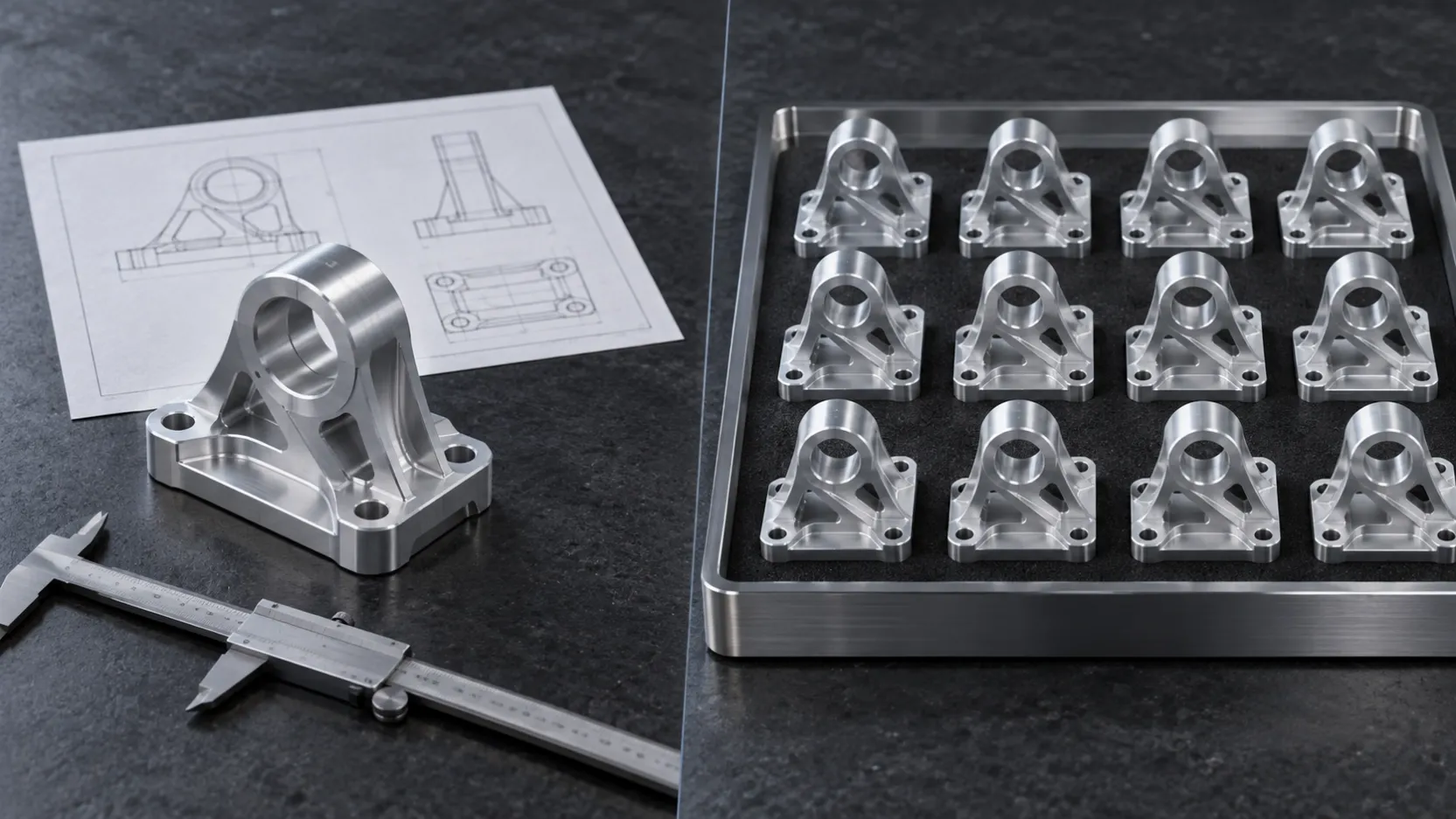
A prototype has one job: answer a question. Does the shape fit? Will the mechanism move? Can the part survive the test? Can the customer hold it and react? The right process depends on the question, not on which process looks cheaper on the first quote.
3D printing and CNC machining are both useful for prototypes, but they answer different questions. 3D printing is excellent for early form, fit, complex geometry, and fast iteration. CNC machining is stronger for functional testing, tight tolerances, real materials, surface finish, and the transition to production. Many teams use both, in sequence.
This guide is written for hardware founders, product managers, and design engineers who need to choose a process for a prototype or a small batch. It covers what each process does well, how cost is really driven, where strength and tolerance differ, when to switch, and what to put in the RFQ.
The Short Answer
Use 3D printing when the main question is shape, fit, ergonomics, or a complex geometry that is difficult to machine, and when the part does not need to carry a real load or hold a tight tolerance. Use CNC machining when the part must use the production material, hold a real tolerance, survive a functional test, include threads or bearing fits, or look and feel like the final product. Switch to CNC when strength, temperature, wear, sealing, or assembly forces become part of the test. For many projects, the most efficient path is a 3D printed concept model followed by a CNC functional prototype.
What Each Process Does Well
3D printing builds a part by adding material layer by layer. The common processes for prototypes include FDM, SLA, SLS, MJF, and metal printing. Each has its own material, resolution, and post-processing. 3D printing is strong at complex internal channels, lattices, undercuts, and shapes that would require multiple setups or special tooling in machining. It is also fast for a single iteration, especially when the design changes every day.
CNC machining removes material from a solid block. It uses real engineering materials, including aluminum, stainless steel, titanium, brass, plastics, and high-performance polymers. It can hold tight tolerances, produce threads and bearing fits, and create a surface finish that matches the production part. It is strong at functional testing because the material and the process are closer to the final product.
The two processes are not competitors in every case. They are tools for different stages of the same project.
How Cost Is Really Driven
A first quote can be misleading if it compares only the unit price. The cost of a prototype includes the design iterations, the time to receive the part, the cost of the test, and the cost of the decision.
3D printing cost is driven by the build volume, the print time, the support structure, the material, and the post-processing. A small part with a simple shape may be inexpensive. A large part, a high-resolution resin part, or a metal printed part can be expensive. The cost per part often drops slowly with quantity because the setup and the build time are shared across the batch.
CNC machining cost is driven by the setup, the programming, the fixtures, the material, the machining time, and the inspection. The first part carries most of the setup cost. The cost per part drops faster with quantity because the setup is amortized. A simple part in a soft material may be competitive with 3D printing at a low quantity. A complex part in a hard material may be more expensive, but it may be the only way to answer the functional question.
The right comparison is not "3D printing versus CNC" in general. It is "the cost of this part, in this material, at this quantity, with this tolerance, delivered by this date."
Strength and Material Properties
A prototype that is only a shape can be made from almost anything. A prototype that must survive a load, a temperature, a chemical, or a fatigue cycle needs the right material and the right process.
3D printed parts can be strong, but their properties depend on the process, the material, the build orientation, and the layer adhesion. Parts made by material extrusion often have anisotropic strength: the bond between layers may be weaker than the material itself. Resin parts can be brittle. Powder-based processes can have porosity. Metal printing can produce excellent parts, but the material, the post-processing, and the qualification are more complex.
CNC machined parts are made from wrought or extruded stock, so the material properties are closer to the datasheet. The grain direction and the machining process can affect fatigue and stress, but the part does not have layer adhesion as a failure mode. For functional testing of threads, snap fits, bearing fits, seals, and structural parts, CNC is often the more representative choice.
Tolerances and Surface Finish
3D printing has improved dramatically, but it is not the same as machining. A printed part may fit a cosmetic model, but a bearing bore, a seal groove, or a mating surface may need machining or post-processing.
CNC machining can hold tight tolerances on critical features and produce a surface finish that matches the drawing. It can also produce threads, reamed holes, and precise flat surfaces. If the prototype must assemble with a production part, or if the test depends on a precise fit, CNC is usually the safer choice.
The tolerance requirement should be functional. Do not specify a tight tolerance on every feature just because the process can. A tight tolerance on a non-functional surface adds cost without adding value.
When 3D Printing Is the Better Choice
3D printing is often the best choice in these situations.
The design is still changing every day, and the team needs a physical model to review the shape, the ergonomics, or the proportions. The part has internal channels, lattices, or organic shapes that would be expensive or impossible to machine. The part is a fit-check model that does not need to carry a load. The part is a one-off fixture, a mask, or a visual aid. The team needs a quick sample for a customer or an investor, and the appearance matters more than the material.
In these cases, the speed of iteration and the freedom of geometry are worth more than the material accuracy.
When CNC Machining Is the Better Choice
CNC machining is often the best choice in these situations.
The part must be tested under real load, heat, wear, or pressure. The part must use the production material. The part has threads, bearing fits, seal grooves, or precision bores. The part must assemble with other production parts. The surface finish or the appearance must match the final product. The part is a bridge to production, and the team wants to validate the machining process, the supplier, and the inspection plan.
In these cases, the value of the prototype is the confidence it gives the team. A cheaper model that does not answer the question is not cheaper in the end.
The Hybrid Path
Many successful projects use both processes.
The team prints early concept models to check the shape and the ergonomics. When the design is stable, it machines a functional prototype in the production material to test the threads, the fits, the seals, and the load. The machined prototype becomes the reference for the production drawing and the inspection plan. The 3D printed parts remain useful for fixtures, masks, and internal review.
A hybrid path can reduce the number of CNC iterations and still give the team the confidence it needs. The key is to define what each prototype must answer before choosing the process.
A Decision Checklist
Ask these questions before choosing a process.
What question must this prototype answer? Does it need the production material? Does it need to hold a tolerance, a thread, a bearing, or a seal? Will it be tested under load, heat, or chemicals? How many parts are needed? How soon? Will the design change after this round? Does the part have a geometry that is difficult to machine? What surface finish is required? What is the cost of a wrong decision?
If the part is for form and fit only, 3D printing may be enough. If the part is for function, use the process and material that represent the final part. If the part is a bridge to production, involve the machining supplier early and ask for DFM feedback.
Prototype to Production Handoff
A prototype is not a production part. The handoff should be planned.
Freeze the design and the material before the production quote. Review the drawing for manufacturability. Define the critical tolerances and the inspection method. Confirm the surface finish and the special processes. Run a first article inspection and compare it with the prototype. Document the process and the inspection plan. Agree on the change control process for the production phase.
A prototype made by CNC is not automatically production-ready. The prototype may use a different setup, a different tool, or a different inspection method. The production process should be validated separately.
FAQ
Is CNC stronger than 3D printing?
It depends on the material and the process. A CNC part made from a wrought engineering material is often stronger and more consistent than a 3D printed part, especially in the layer direction. Metal 3D printing can produce strong parts, but the material and the post-processing must be qualified for the application.
Is 3D printing always cheaper for prototypes?
No. For a small, simple part, 3D printing may be cheaper and faster. For a part that needs a real material, a tight tolerance, or a functional test, a CNC prototype may be the lower-risk choice even if the unit price is higher.
Can I use a 3D printed part for production?
It depends on the application, the quantity, and the material. Some production parts are 3D printed, especially in low volumes or complex geometries. For many structural, sealing, or wear applications, CNC or another production process is more appropriate. The decision should be based on the requirements, not on the prototype process.
How many prototypes should I make?
Make enough to answer the question and to test the assembly. A single prototype may be enough for a form check. A functional test may need several parts, especially if the test is destructive. Plan the quantity with the test in mind.
Can you machine a prototype from the same material as production?
Yes, in many cases. The supplier should confirm the material availability, the condition, and the tolerance. If the production material is difficult to machine, the prototype may need a different process or a different condition. Discuss the material and the test requirements before quoting.
Choosing a Prototype Manufacturing Partner
A prototype supplier should ask what the part must prove, not just what the drawing says. The supplier should be able to explain the process, the material, the tolerance, the inspection, and the path to production.
Zync Precision is an ISO 9001-certified manufacturer of custom CNC machined parts for medical, aerospace, consumer electronics, and automotive applications. We machine prototypes and low-volume production parts from customer drawings and CAD files, with material traceability, dimensional inspection, and production support. Our engineering team reviews drawings, materials, tolerances, surface finishes, and delivery requirements, and responds to quote requests within 24 hours. If you are deciding between 3D printing and CNC for a prototype, send your drawing, material, quantity, tolerance, test requirement, and target date.
Request a CNC machining quote and let us review your prototype.