Sep 1, 2026Case Studies
Case Study: Ra 0.3 μm Finish on AISI 1045 Steel
Case study of an AISI 1045 steel component achieving Ra 0.3 μm through turn-mill machining, with concentricity control, plating allowance, dimensional inspection, and reduced secondary grinding.
Project Overview
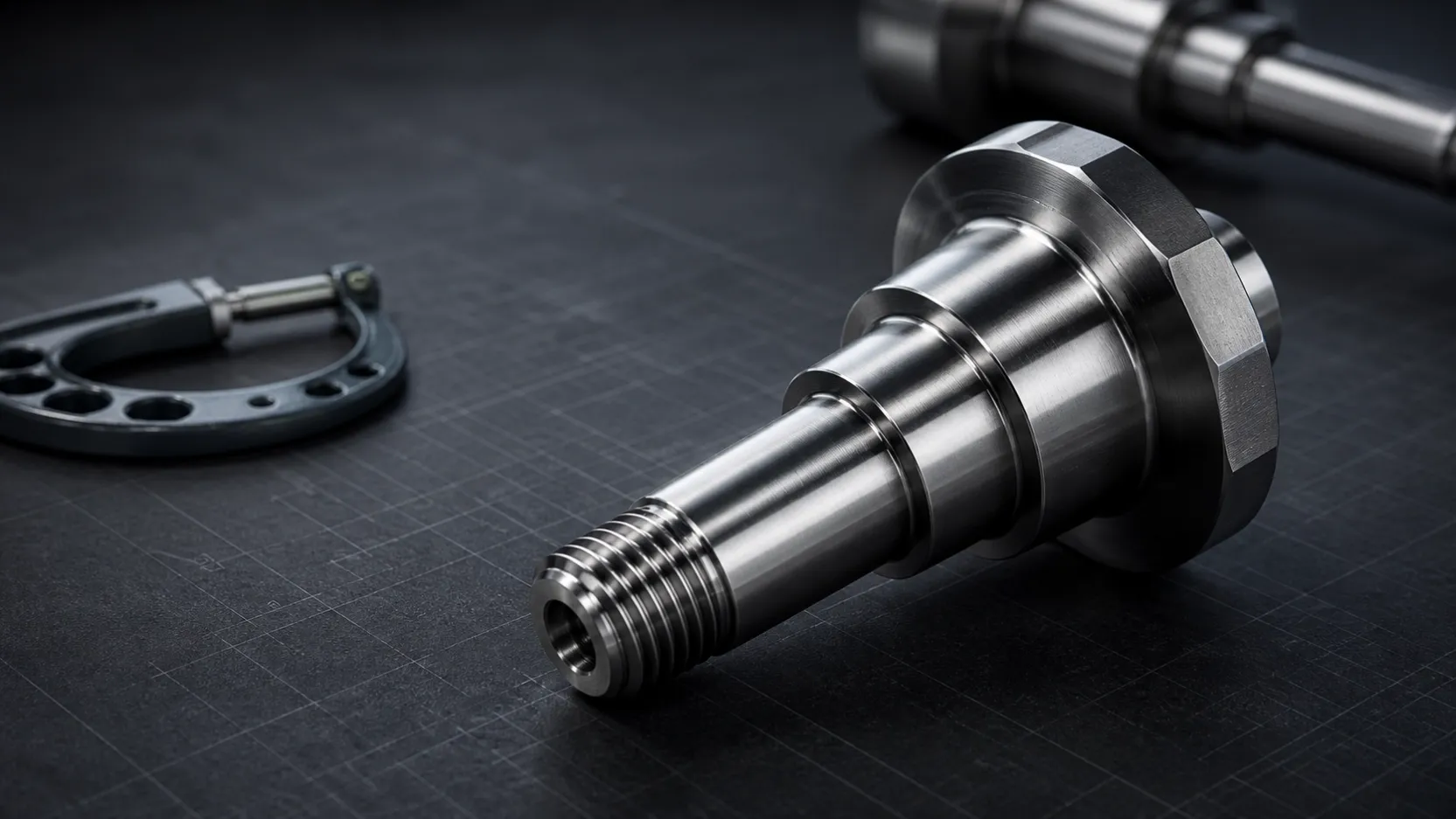
Zync Precision manufactured a custom AISI 1045 steel component requiring complex turned and milled features, controlled concentricity, and an exceptionally smooth machined surface.
Material: AISI 1045 medium-carbon steel
Manufacturing Process: CNC turn-mill machining
Surface Finish: Ra 0.3 μm achieved on specified machined surfaces
Secondary Treatment: Color zinc plating according to project requirements
The component included a threaded end, precision shaft, multiple stepped diameters, and milled flats on the head. Completing these features in separate setups could introduce concentricity and positioning errors, so a turn-mill process was selected to reduce re-clamping.
Technical Challenges
Achieving a Fine Surface Finish
AISI 1045 steel offers good strength, machinability, and wear resistance, but achieving a very low surface roughness requires careful control of tooling, machine stability, cutting parameters, chip evacuation, and vibration.
The customer drawing specified critical surface and dimensional requirements. Process development was therefore focused on producing a stable finish while maintaining the required geometry.
Complex Turned and Milled Features
The component combined several manufacturing requirements:
• External threads
• Precision cylindrical surfaces
• Multiple stepped diameters
• Milled flats on the component head
• Tight positional relationships between features
• Controlled concentricity between the shaft and head
Producing these features across multiple machines would increase handling and alignment risk.
Plating Allowance
Color zinc plating adds material to the component surface. The coating thickness can affect external dimensions, thread fit, and other critical features.
Pre-plating dimensions therefore needed to account for the specified coating requirement. Final dimensions and inspection criteria were evaluated according to the customer drawing and approved process.
Turn-Mill Manufacturing Strategy
A CNC turn-mill machining center was used to complete the principal turned and milled features in one coordinated setup.
This approach provided several advantages:
• Reduced re-clamping between turning and milling operations
• Improved positional consistency between related features
• Better control of shaft-to-head concentricity
• Lower risk of handling and alignment errors
• More efficient production of complex geometries
• Stable repeatability for future orders
The process sequence was planned around critical datums, surface-finish requirements, tool access, and inspection points.
Tooling and Cutting-Parameter Control
The machining process used appropriate finishing tools and controlled cutting conditions for AISI 1045 steel.
Key considerations included:
• Tool geometry and edge condition
• Machine and workholding rigidity
• Cutting speed and feed rate
• Depth of cut during finishing passes
• Chip control and evacuation
• Coolant application
• Vibration and tool runout
• Consistent finishing allowance
Finishing parameters were adjusted during process validation to achieve the required surface quality without compromising dimensional accuracy.
Surface-Finish Control
The Ra 0.3 μm result applied to the specified machined surfaces evaluated for this project. Surface roughness capability depends on the component geometry, material condition, feature accessibility, tooling, and inspection method.
For new projects, Zync Precision reviews the required surface finish during quotation and confirms feasibility based on the drawing and application.
Inspection and Quality Control
Inspection was integrated into the manufacturing process.
Quality-control activities included:
• Incoming material verification
• First-article dimensional inspection
• In-process measurement of critical diameters
• Thread inspection
• Concentricity and runout verification
• Inspection of milled features
• Surface-roughness measurement on specified surfaces
• Pre-plating dimensional verification
• Final inspection according to project requirements
Inspection reports and project-specific quality documentation can be provided according to customer requirements.
Zync Precision operates ISO 9001 and IATF 16949 certified quality management systems.
Project Results
The approved turn-mill process achieved the required component geometry and a measured surface roughness of Ra 0.3 μm on the specified machined surfaces.
The project demonstrated the following results:
• Complex turned and milled features completed in a coordinated setup
• Reduced re-clamping and alignment risk
• Controlled concentricity between related features
• Stable critical dimensions before plating
• Ra 0.3 μm finish achieved on specified surfaces
• Inspection completed according to project requirements
• A repeatable process established for future production
The result shows how turn-mill machining, appropriate tooling, controlled finishing parameters, and dimensional inspection can support demanding steel-component applications.
Applications
Precision turn-mill components made from AISI 1045 steel may be used in:
• Industrial automation equipment
• Railway transportation systems
• Automotive equipment
• Hydraulic and pneumatic assemblies
• Machinery and production equipment
• Fixtures and tooling
• Motion-control systems
• Custom industrial assemblies
Actual material, heat treatment, coating, tolerances, and inspection requirements should be selected according to the component application.
Request a Turn-Mill Machining Quote
Zync Precision provides custom CNC turning and turn-mill machining for prototypes, low-volume projects, and repeat production.
For a manufacturing review and quotation, please provide:
• 2D drawings or 3D CAD files
• Material and material condition
• Required quantity
• Critical dimensions and tolerances
• Surface-roughness requirements
• Heat-treatment or plating requirements
• Inspection and documentation requirements
• Expected delivery date
Our engineering team will review manufacturability, surface-finish feasibility, inspection requirements, production process, and expected lead time before quotation.
Frequently Asked Questions
Can turn-mill machining reduce secondary grinding?
For suitable components and specified surfaces, optimized turn-mill finishing may achieve a fine surface without conventional secondary grinding. Feasibility depends on the material, geometry, tolerance, surface requirement, and inspection method.
Can you achieve Ra 0.3 μm on every CNC-machined component?
No single surface-finish value should be guaranteed for every component. Capability depends on material, geometry, feature accessibility, tooling, machine stability, and measurement requirements. Each project must be reviewed individually.
Why use turn-mill machining for complex components?
Turn-mill machining combines turning and milling operations in a coordinated setup. It can reduce re-clamping, improve positional consistency, and simplify production of components containing both cylindrical and milled features.
How do you compensate for plating thickness?
The required coating thickness and critical final dimensions are reviewed before machining. Pre-plating dimensions and inspection criteria are then established according to the drawing and approved process.
Can you provide surface-roughness and dimensional inspection reports?
Yes. Surface-roughness measurements, dimensional inspection reports, first-article inspection, and other documentation can be provided according to project requirements.
Are customer drawings kept confidential?
Yes. Customer drawings and project information are handled confidentially. NDA arrangements are available upon request.