CNC Machining Guides
Automotive CNC Machining: PPAP and Consistency
A buyer's guide to automotive CNC machining: PPAP levels, material and heat-treatment control, tolerances, surface treatment, production consistency and supplier checklist.
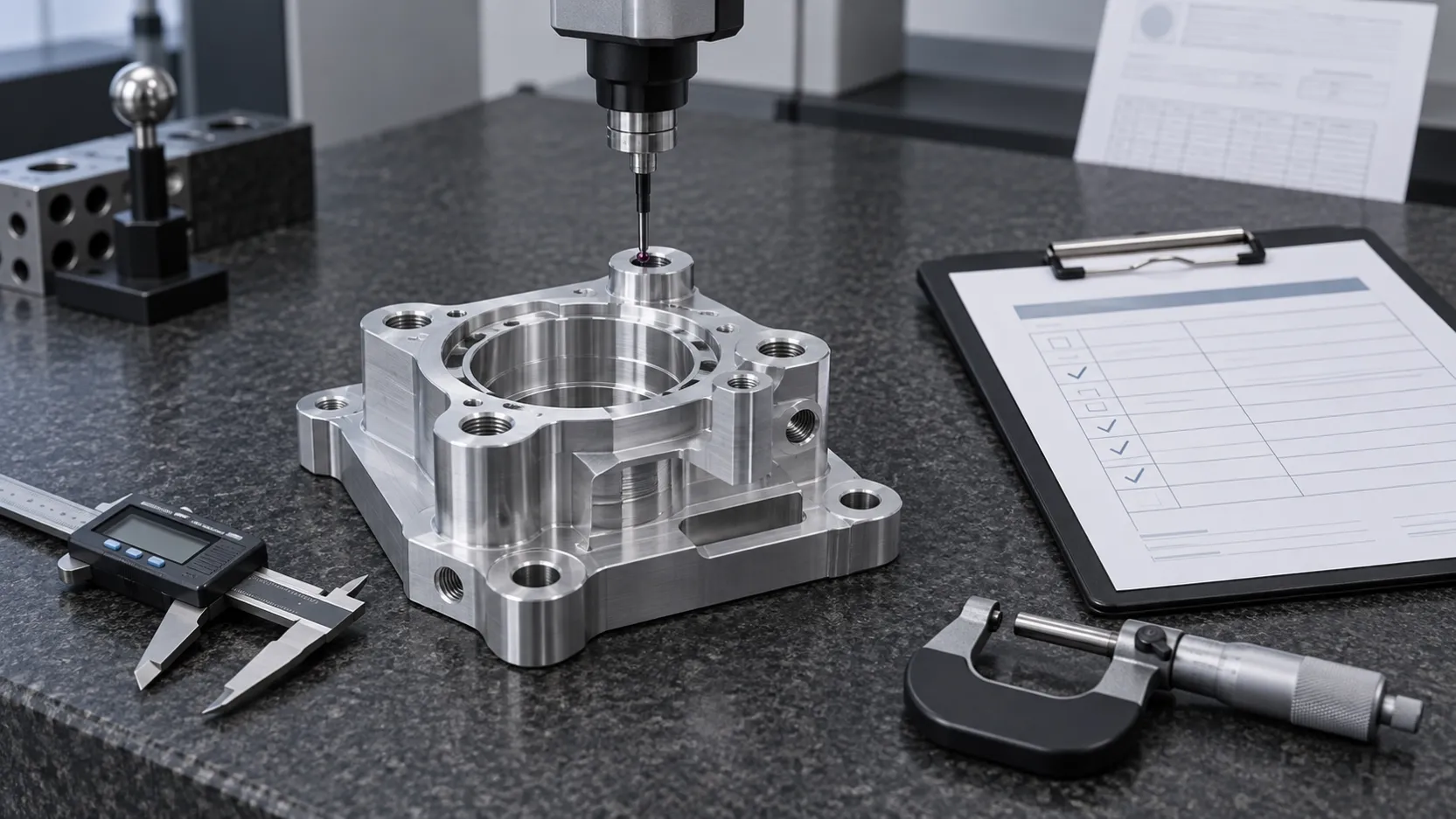
A bracket arrived with the right dimensions and still failed the customer's supplier review. The drawing was correct. The PPAP package was not: the heat-treatment certificate did not match the process, the control plan was generic, and the inspection report did not cover the critical feature.
Automotive parts are not only precision parts. They are parts that must be produced under a controlled process, documented to the customer's PPAP level, and changed only with approval. A part that measures correctly in the first article can still fail the launch if the process and the documentation are not in place.
This guide is written for automotive buyers, quality engineers, and suppliers who need custom CNC machined components. It covers PPAP, materials and heat treatment, tolerances, surface treatment, production consistency, and the questions to ask before placing an order.
The Short Answer
Specify the PPAP level, the material and heat-treatment requirement, the critical features and inspection method, the surface treatment, and the change control process. A first article is not a PPAP package. The supplier must be able to show a controlled process, a control plan, material certificates, dimensional results, and a plan for keeping the process stable in production.
What Automotive Parts Demand
Automotive components are produced in a supply chain where a small process change can create a large risk. The buyer needs confidence that the part will be the same in the first shipment and in the thousandth.
That means the supplier must control the material, the process, the tooling, the inspection, and the change. The PPAP process exists to document that control. A supplier that can machine a good sample but cannot document the process is not ready for automotive production.
Common Automotive Parts We Machine
Automotive machining covers a wide range of components.
Brackets and mounts often have hole patterns, thin flanges, and weight-saving pockets. Housings and covers may have sealing surfaces and thin walls. Bushings, sleeves, and shafts require control of bore size, roundness, and surface finish. Sensor mounts and adapter plates must hold position and flatness. Prototype parts and low-volume production components may use the same materials and processes as the production part.
Each part has a different critical feature. A bracket may be defined by hole position and flatness. A housing may be defined by a seal surface and a bore. A shaft may be defined by diameter, roundness, and surface finish. The drawing and the control plan should reflect the function.
Materials and Heat Treatment
The material and the heat treatment are part of the PPAP record.
Common materials include 6061 and 7075 aluminum, carbon and alloy steel, stainless steel, brass, and engineering plastics. The grade, temper, and condition should be stated on the drawing and the purchase order.
If the part requires heat treatment, the process should be specified. The heat-treatment supplier should be approved, and the certificate should match the lot. Distortion after heat treatment can affect the final dimensions, so the machining sequence and the stock allowance should be planned.
Material substitution is not a minor change. A different grade, condition, or supplier can change the strength, the corrosion resistance, the machinability, and the PPAP. The customer should approve any substitution before production.
PPAP and Documentation
PPAP, the Production Part Approval Process, is the automotive method for demonstrating that the production process can consistently meet the requirements. The required level depends on the customer and the part.
Level 1 is generally a Part Submission Warrant with limited supporting data. Level 3 is often the default: the warrant, samples, and the full supporting data. Level 5 includes a review at the supplier's site. The exact requirements should come from the customer's PPAP manual, not from a generic template.
The supporting package can include design records, engineering change documents, process flow diagrams, PFMEA, control plans, MSA studies, dimensional results, material and performance test results, initial process studies, lab documentation, and the Part Submission Warrant. Not every part needs every element, but the package should match the customer's requirement.
Zync Precision holds ISO 9001 and IATF 16949 certifications and supports PPAP documentation. The PPAP level and the required elements should be stated in the RFQ so the quote and the launch plan reflect the work.
PPAP Elements in Practice
The PPAP package is not a folder of documents. Each element answers a question about the process.
The process flow diagram shows the steps from incoming material to shipment. The PFMEA identifies the failure modes and the actions that reduce the risk. The control plan translates the risks into the characteristics, the sampling, the measurement method, and the reaction plan. The MSA shows that the measurement system can distinguish good parts from bad. The dimensional results show that the part meets the drawing. The material and performance test results show that the material and the product meet the specification.
The Part Submission Warrant is the summary. It states that the supporting data is complete and that the supplier is ready for production. A warrant without the supporting data is not a PPAP.
For a machining supplier, the critical elements are usually the control plan, the dimensional results, the material certificate, and the change control. The PFMEA and the MSA may be led by the customer or the supplier, depending on the program. The PPAP level and the customer-specific requirements define the exact package.
Launch and Production Ramp
The launch is a separate risk from the prototype. The supplier must be ready to produce at the required volume, with the same process and the same inspection.
A pilot lot is the first production-representative batch. It should use the production process, the production tooling, the production suppliers, and the production inspection. The pilot lot is the chance to find the problems before the volume ramp.
The supplier should plan the capacity, the tooling, the material, the packaging, and the contingency. If the launch volume is higher than the prototype volume, the supplier should show how the process will scale without changing the critical parameters. A safe launch plan can include additional inspection for the first shipments and a review of the data before the volume increases.
Tolerances and Inspection
Automotive parts often have tight tolerances on features that affect fit, sealing, safety, and assembly. The achievable tolerance depends on the geometry, the material, the setup, and the inspection method.
A general tolerance on the drawing is not enough for a critical feature. The drawing should identify the critical dimensions, the datum scheme, and the inspection method. A CMM can verify the position, the profile, and the datum scheme. For a critical bore, the roundness and the surface finish may matter as much as the diameter.
Production inspection should be planned with the part. The control plan should identify the characteristics, the sampling, the measurement method, and the reaction plan. If a characteristic is critical, the supplier should show that the measurement system is capable and that the process is stable.
Surface Treatment and Corrosion
Surface treatment is part of the automotive requirement, not a cosmetic option.
Anodizing, plating, passivation, and coating can improve corrosion resistance, wear resistance, and appearance. The specification, the thickness, the masking, and the acceptance criteria should be stated on the drawing.
A coating can affect the dimension and the fit. A plated thread may need an allowance; an anodized bore may need masking. The surface treatment supplier should be approved, and the process should be documented in the PPAP package.
Corrosion testing may be required for some parts. The test method, the duration, and the acceptance criteria should be agreed before production.
Production Consistency and Change Control
The first article proves that the process can make a good part. Production consistency proves that it can keep making good parts.
The supplier should control the process, the fixtures, the tooling, and the inspection. The control plan should define the sampling and the reaction plan. The PFMEA should identify the risks and the actions. The MSA should show that the measurement system is adequate.
Change control is critical. A change in material, process, machine, tooling, inspection, or subcontractor can affect the part. The supplier should notify the customer before the change and follow the customer's approval process. A silent change is a quality risk and a PPAP violation.
Supplier Checklist for Automotive Parts
Ask these questions before placing the order.
What PPAP level and elements are required? Can you provide the material certificate and the heat-treatment certificate? What is your control plan for the critical features? How do you control the process and the tooling over time? What is your change control process? Can you provide MSA and initial process studies if required? How do you handle a nonconformance and a corrective action? Can you support a launch and a production ramp? What is your capacity and lead time? Have you made a similar automotive part before?
The answers should be specific. A supplier that says yes to everything without evidence is not an automotive supplier.
What to Put in the RFQ
State the PPAP level, the material and heat treatment, the critical features, the tolerance and inspection method, the surface treatment, the packaging, and the delivery requirement.
State the annual volume, the launch quantity, and the expected production life. The supplier needs this information to plan the process, the tooling, and the capacity.
State the change control requirement and the documentation package. If the customer has a supplier manual or a specific PPAP template, include it in the RFQ.
FAQ
What PPAP level should I require?
It depends on the customer and the part. Level 3 is common, but the customer's PPAP manual defines the requirement. State the level in the RFQ so the supplier can plan the documentation.
What is a control plan?
A control plan is the production document that lists the characteristics to be controlled, the sampling, the measurement method, and the reaction plan. It connects the PFMEA risks to the daily production inspection.
What is an AAR?
An AAR is an Appearance Approval Report, used when the part has a cosmetic or appearance requirement. It documents the color, the grain, the gloss, or other visual acceptance criteria. Not every part needs one; the customer's PPAP manual defines the requirement.
Do you hold IATF 16949?
Yes. Zync Precision holds ISO 9001 and IATF 16949 certifications. The certificate scope and the customer-specific requirements should be confirmed for the program.
Can you provide material and heat-treatment certificates?
Yes. Material certificates and heat-treatment records can be included in the PPAP package. The lot traceability should be agreed before production.
Can you support a prototype and a production launch?
Yes. We machine prototypes, low-volume production, and repeat orders. The PPAP and inspection plan can be scaled to the program requirement.
How do you control process changes?
Changes in material, process, machine, tooling, inspection, or subcontractor are reviewed with the customer before implementation. The PPAP may need to be updated.
Choosing an Automotive Machining Supplier
An automotive supplier should understand the PPAP requirement, the process control, and the change control. The supplier should be able to discuss the material, the heat treatment, the critical features, the inspection, and the documentation in specific terms.
Zync Precision is an ISO 9001 and IATF 16949 certified manufacturer of custom CNC machined parts for medical, aerospace, consumer electronics, and automotive applications. We machine aluminum, steel, stainless, brass, and engineering plastics, with material traceability, dimensional inspection, PPAP support, and production support. Our engineering team reviews drawings, materials, tolerances, surface finishes, and delivery requirements, and responds to quote requests within 24 hours. If you are sourcing automotive components, send your drawing, material, PPAP level, critical features, surface treatment, annual volume, and destination.
Request a CNC machining quote and let us review your automotive project.